India generates 34.7 lakh tonnes of plastic waste every year. That is not a statistic anyone wants to sit with for too long. But it is real.
What most people don’t realise is that even inside the recycling ecosystem, there exists a hierarchy of materials.
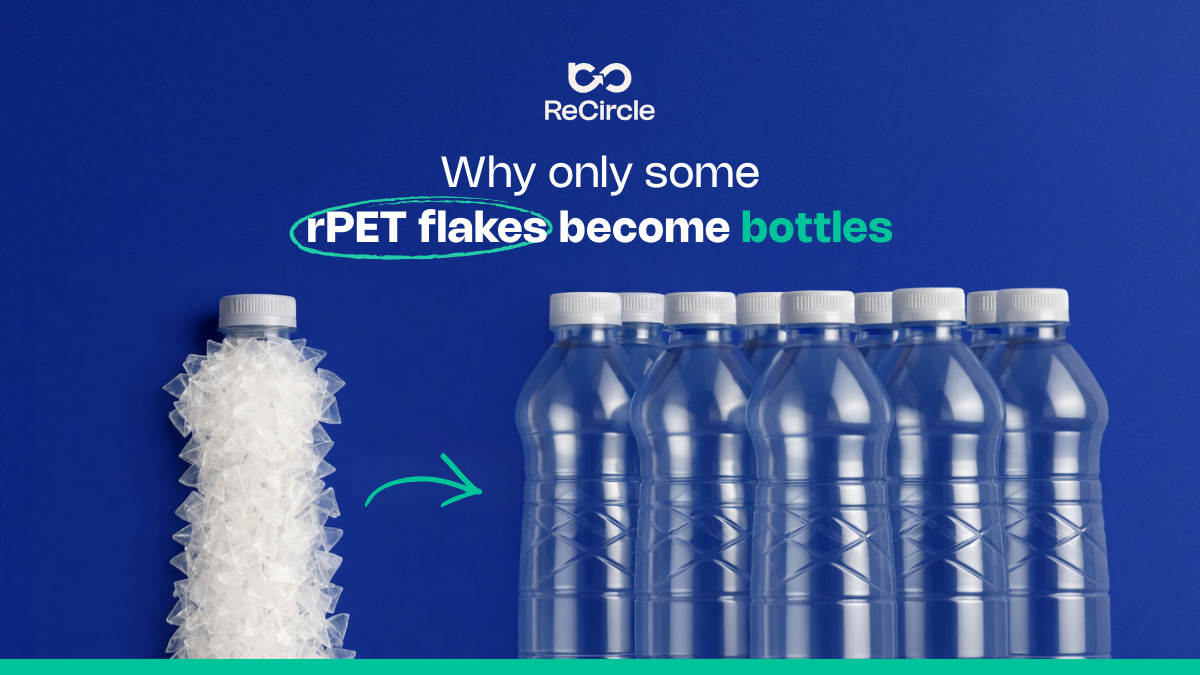
All bottles are recycled into rPET flakes, but not all of them can be turned back into bottles. And that difference changes everything.
The illusion of “recycled is recycled”
When a used PET bottle is collected, cleaned, processed, and shredded, it becomes recycled PET flakes, or rPET flakes. To the untrained eye, most flakes appear identical. clear pieces. similar size. packed in bulk bags.
But appearances can be misleading.
When plastic is used to package drinking water, soft drinks, edible oil, or any consumable product, regulators step in. In India, agencies like BIS and FSSAI require clear proof that recycled PET has been properly decontaminated and meets safe migration limits.
That means the recycling process must remove unknown contaminants that may have entered the material during its first life. If it cannot, the material is redirected into other applications such as fibres, sheets, or strapping. Useful? Definitely. But not suitable for closed-loop, food-grade packaging.
So what really separates food-grade rPET flakes from the rest?
It starts before recycling even begins
Bottle-to-bottle recycling does not begin at the recycling plant. It begins at collection.
If post-consumer PET is mixed with PVC, multilayer plastics, oil containers, or chemical residues, contamination risks rise sharply. And some forms of contamination cannot be reversed later.
That is why segregation matters. That is why traceable sourcing matters.
High-quality rPET flakes come from controlled post-consumer PET streams, where input is predictable and monitored. Without that discipline at the start, the output can never qualify as food-grade.
Cleaning is a science, not just washing
Many people imagine recycling as a powerful rinse cycle. It is much more layered than that.
Food-grade rPET flakes undergo high-temperature washing, caustic treatment, friction cleaning and drying under strict process control. The goal is to remove adhesives, inks, residues and microscopic contaminants that are invisible to the eye.
But the real test comes next.
Regulatory bodies require validated decontamination processes. Recycling systems must prove, through challenge testing, that potential contaminants are reduced to safe migration limits. These are not internal quality checks. They are formal compliance benchmarks.
If a recycling process cannot demonstrate this scientifically, the resulting rPET flakes cannot be used in food-contact packaging.
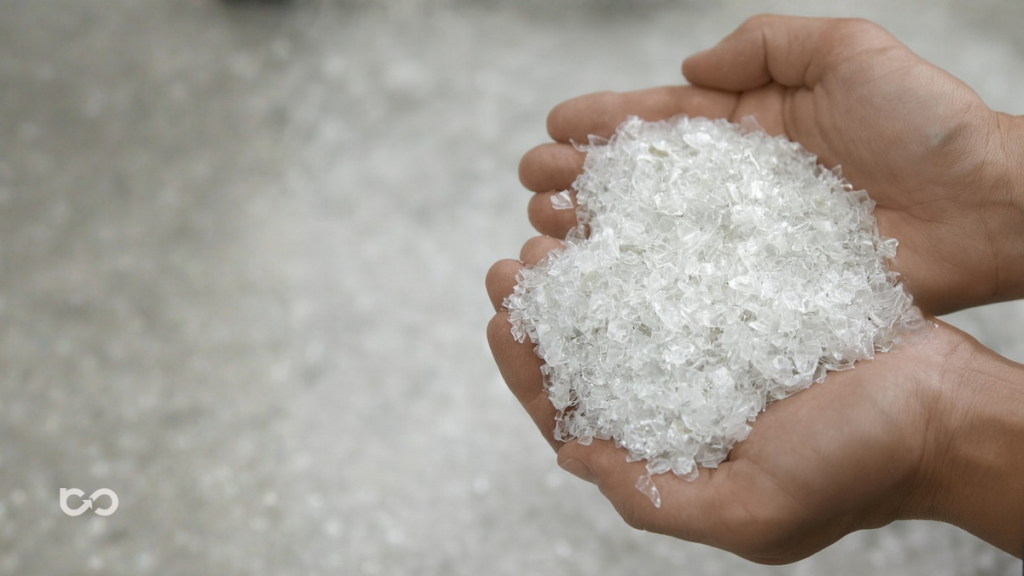
Food-grade rPET flakes carry documentation, not just purity
Even perfectly processed material needs proof.
Food-grade rPET flakes must be supported by traceability records, migration testing, and compliance with relevant regulations. That means every batch must be traceable from the first bottle collected to the final flake produced.
Why many rpet flakes get downgraded
Recycling infrastructure often prioritises throughput. Collect more. Process more. Sell more.
That works for non-food applications. Polyester fibre, for example, does not require the same level of regulatory validation as beverage packaging.
But when the end-use is a water or soft drink bottle, scrutiny increases dramatically. Even minor PVC contamination, residual metal, or inconsistent intrinsic viscosity can disqualify a batch of rPET flakes from bottle-grade use.
Once downgraded, that material rarely moves back up the value chain.
The demand-supply gap is real
Large FMCG and beverage companies have publicly committed to increasing recycled content in their packaging. Many have pledged to incorporate significant amounts of recycled PET by 2030.
At the same time, India’s Extended Producer Responsibility guidelines mandate increasing recycled content in plastic packaging over the coming years.
This creates a supply challenge.
There is demand for food-grade rPET flakes at scale. But supply is limited because not all recycling operations are designed to meet that threshold.
Plastic is not the enemy. Leakage is.
Plastic has protected food, enabled medical innovation, and extended product shelf life in ways that few materials can. The problem begins when it leaks out of the system.
When PET bottles are designed for one life, used once, and discarded without recovery, the system breaks. When they are recovered, processed properly, and transformed into high-quality rPET flakes, they become part of a continuous loop.
So the real question becomes: who is building infrastructure capable of continuing this loop properly?
Where ReCircle comes in
We talk a lot about circularity in theory. But circularity only works when the material works. If the flake is inconsistent or poorly documented, the loop quietly breaks.
At ReCircle, our rPET flakes are built to keep that loop intact. Not as a sustainability statement. But as a production-ready material that performs where it actually matters.
1) robust recovery network
Our rPET flakes are made from post-consumer PET sourced through a pan-India recovery network that actively brings plastic back into circulation. The material is carefully sorted, washed, and processed under tight controls to ensure purity, stability, and performance. From melt strength to cleanliness, every batch is engineered to support demanding applications like bottle and sheet manufacturing without compromising process reliability.
2) transparency and traceability
Circularity only works when it is traceable. Through ClimaOne, we track the journey of plastic from collection to final rPET flakes in real time. This level of transparency helps businesses meet BIS and CPCB compliance requirements while confidently reporting recycled content.
3) tested against EU food-contact regulations
When recycled plastic returns to food packaging, safety cannot be assumed. Our rPET flakes are tested by accredited third parties and evaluated against stringent European food-contact regulations. They meet migration and chemical safety requirements, making them suitable for regulated packaging applications where compliance is essential.
4) state-of-the-art infrastructure
Our advanced recycling facility is designed for precision and consistency. Uniformly processed flakes allow smoother feeding, reduced residue buildup, and more stable production runs. Lower contamination means less wear on machinery and fewer unexpected interruptions. The result is a material that integrates seamlessly into your manufacturing line and behaves predictably, batch after batch.
We believe plastic deserves more than one life, but that second life must be engineered with discipline and accountability.
Reach out to us to explore high-quality food-grade rPET flakes for your manufacturing line.