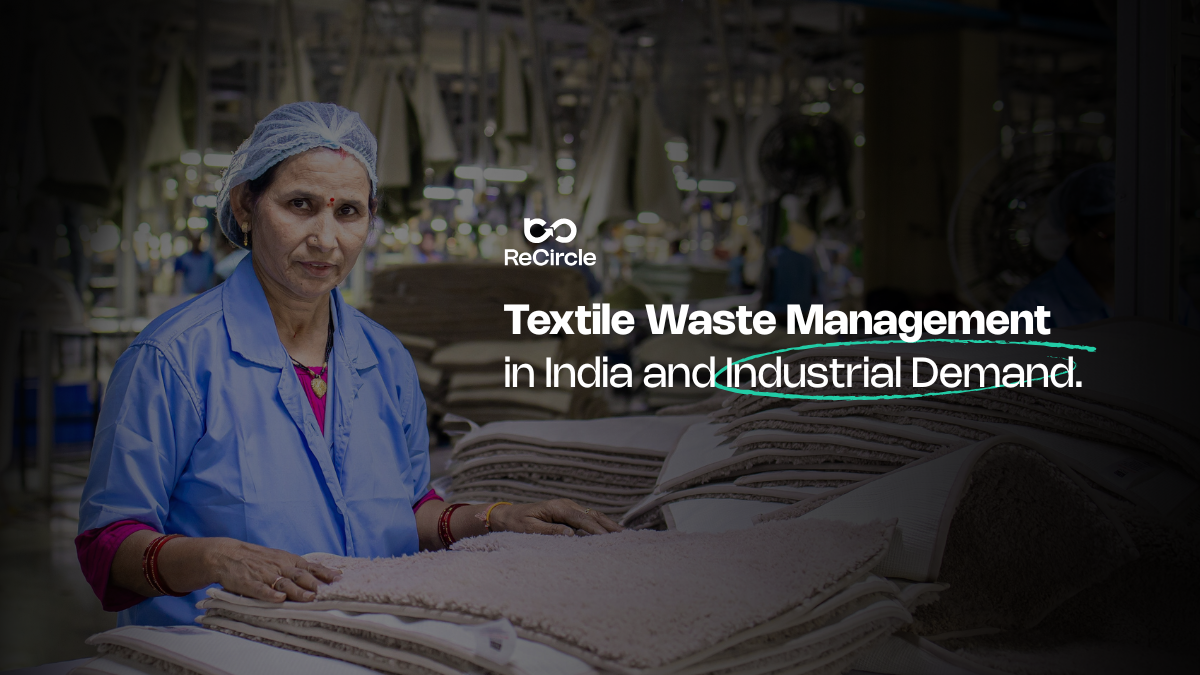
Textile waste management in India is usually discussed in terms of landfills, exports, or donation streams. What is discussed far less is how everyday industrial procurement decisions quietly determine where textile waste actually ends up.
Factories, warehouses, and workshops require ongoing cleaning. Oils, dust, coolants, and residues must be removed throughout the day. Yet most facilities still depend on disposable wipes or low-grade cloths that move quickly from storerooms to bins.
At the same time, India generates millions of tonnes of post-consumer textile waste each year, which struggles to find stable, formal end uses.
These two realities are not separate. They sit on opposite ends of the same system.
Where Textile Waste Meets Industrial Demand
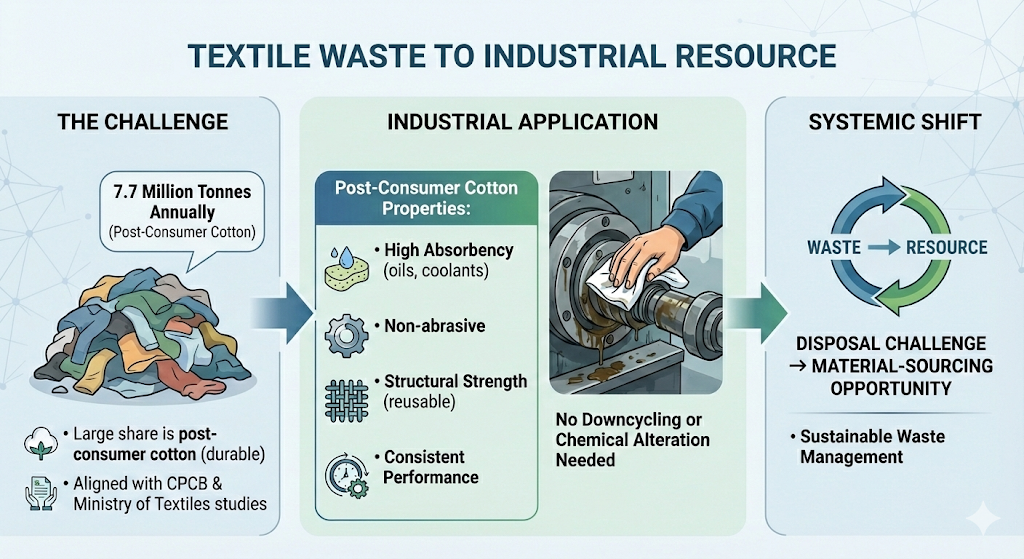
India generates approximately 7.7 million tonnes of textile waste annually, according to studies aligned with the CPCB and the Ministry of Textiles. A large share of this textile waste is cotton-based, post-consumer material that has already demonstrated durability through daily use.
From a systems perspective, industrial cleaning is one of the few applications in which textile waste does not require downcycling or chemical alteration. Cotton T-shirts already meet functional requirements.
Specifically, post-consumer cotton works because it offers:
- High absorbency for oils, coolants, and solvents
- Non-abrasive contact with machinery and finished surfaces
- Structural strength that survives repeated washing
- Consistent performance across routine, high-frequency tasks
This is where textile waste management in India shifts from a disposal challenge to a material-sourcing opportunity.
Why Cotton T-Shirts Perform Reliably on Industrial Floors
Industrial environments prioritise consistency. Cleaning materials must behave consistently across shifts, surfaces, and conditions.
Cotton T-shirts meet this expectation because of their fibre structure, not because of novelty. Their knit construction allows liquids to be absorbed rather than spread. Their softness prevents surface damage. Their strength reduces mid-task failure.
When processed correctly, recycled cotton rags remove variability from daily cleaning routines. That reliability is why they have remained in industrial use for decades, even as disposable alternatives have multiplied.
The Cost and Waste Equation Most Facilities Miss
Disposable cleaning products often appear efficient when viewed line by line in a procurement sheet. The operational impact only becomes visible over time.
Facilities using single-use wipes or low-grade cloths tend to see:
- Higher reorder frequency due to short product life
- Increased storage and inventory handling
- Larger volumes of daily waste are sent for disposal
- Inconsistent cleaning outcomes across teams
Recycled cotton rags made from textile waste change this equation. Because they are reusable, they reduce procurement churn. Because they last longer, they reduce waste output. Because they are made from existing materials, they lower the footprint of routine operations.
In the context of textile waste management in India, this alignment between cost control and waste reduction is rare and valuable.
Why Textile Waste Management in India Needs Industrial Buyers
Most textile waste in India moves through informal networks. Collection exists, but value creation remains limited and inconsistent.
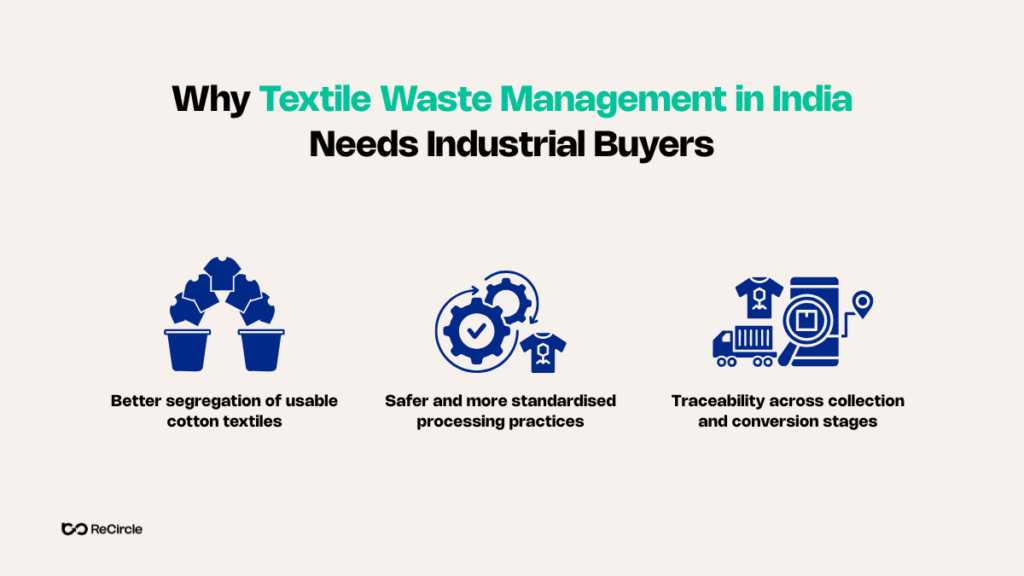
Formal industrial demand changes this dynamic. When facilities source recycled cleaning rags at scale, they create predictable demand for post-consumer textile waste. That demand enables:
- Better segregation of usable cotton textiles
- Safer and more standardised processing practices
- Traceability across collection and conversion stages
Without buyers, textile waste remains a burden. With buyers, it becomes a resource stream.
This is why textile waste management in India cannot scale through policy alone. It scales when businesses participate in the system.
Performance Standards Still Come First
No industrial operation adopts a product purely for sustainability reasons. Performance remains non-negotiable.
For recycled rags, this means strict processing controls. Fabric composition must be verified. Non-textile elements must be removed. Cleaning and cutting must meet hygiene and safety expectations.
When these standards are met, recycled cotton rags do not introduce operational risk. They reduce variability and support safer, more predictable workflows.
Where ReCircle Fits into This System
ReCircle operates at the intersection of textile waste management in India and industrial utility.
Post-consumer textile waste is collected through verified channels, sorted for quality, processed responsibly, and converted into industrial cleaning rags designed for consistent performance.
This ensures that textile waste is not merely diverted but integrated into formal supply chains, where its value can be measured, tracked, and scaled.
Turning Textile Waste Management into a Scalable Industrial Solution
Industrial cleaning rarely features prominently in sustainability discussions, even though it is among the most frequent and resource-intensive activities in industrial facilities.
Replacing disposable cleaning products with recycled cotton rags does not require operational redesign. It involves aligning procurement practices with waste management systems.
In a country facing rapidly increasing volumes of textile waste, these alignments matter. When textile waste is treated as an industrial input rather than an inevitable outcome, textile waste management in India becomes operational, scalable, and economically relevant.
If consistent cleaning performance is important to your operations, connect with ReCircle for high-performance industrial cleaning rags suitable for all industrial applications.
Frequently Asked Questions
- Highly absorbent for oils and liquids
- Non-abrasive on machinery and surfaces
- Strong enough for repeated washing
- Consistent in performance across daily tasks