Plastic has changed modern life in ways we rarely think about. It keeps food safe, medicines sterile, and supply chains efficient. But here’s the catch. The world now produces more plastic than it knows what to do with.
According to the OECD’s Global Plastics Outlook, the world generated around 353 million tonnes of plastic waste in 2019, of which only about 9% was recycled globally. PET bottles perform slightly better, with global recycling rates of around 55%. Still, the gap between what we collect and what we can truly reuse remains wide.
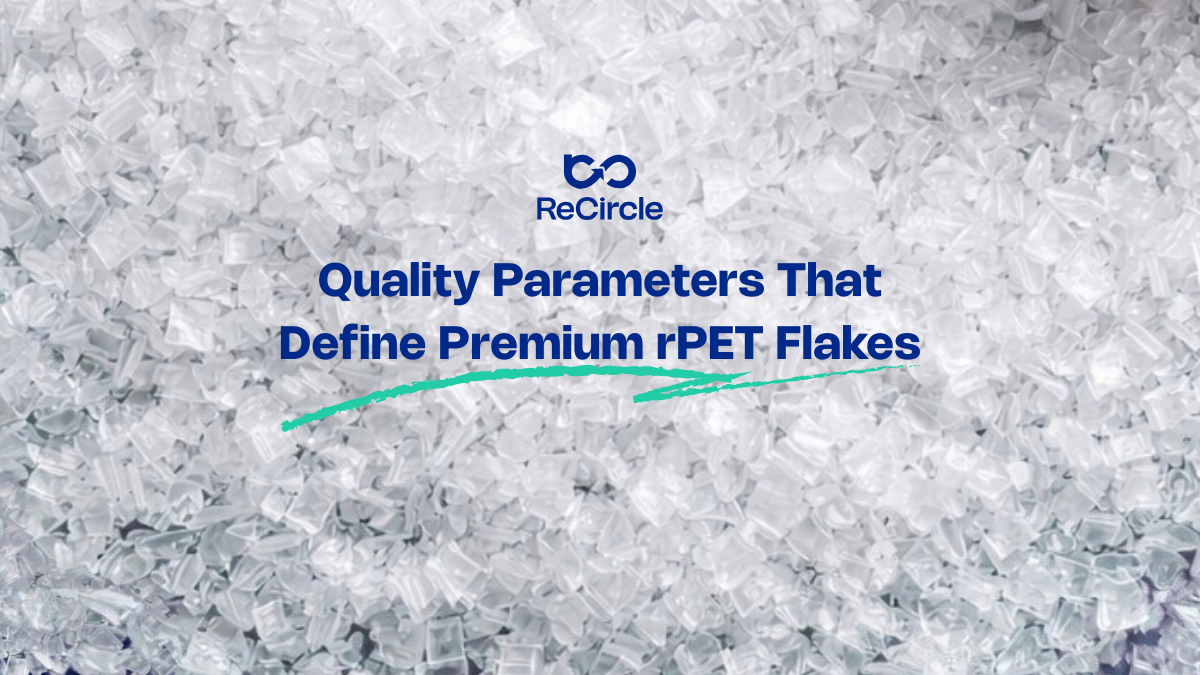
This is where rPET flakes come into the conversation. Not all recycled PET is high-quality. Because the process of producing high-quality rPET recycled plastic flakes involves more than just shredding plastic.
Three quality parameters quietly determine whether recycled PET becomes bottle-grade packaging again or ends up as lower-value material: intrinsic viscosity, moisture, and contamination.
Let’s unpack what they are and why they matter.
What separates ordinary PET from premium rPET flakes?
Walk into a typical plastic recycling facility, and you’ll see bottles being washed, shredded and converted into recycled plastic flakes.
At a glance, the output might look identical across plants.
But converters and packaging manufacturers know better.
When these flakes go through extrusion or injection moulding, their behaviour reveals everything. Some batches process smoothly and produce clear, strong bottles. Others create haze, break polymer chains, or destabilise production lines.
The difference usually comes down to how carefully the recycling process protects the polymer itself.
That protection begins with intrinsic viscosity.
Intrinsic viscosity: The backbone of rPET flakes
Intrinsic viscosity, aka IV, is the clearest indicator of any recycled plastic’s quality. IV reflects the length of polymer chains inside PET. Longer chains mean stronger mechanical performance. Shorter chains mean weaker material that struggles to hold pressure or maintain clarity.
Virgin PET used for beverage bottles usually has an IV of around 0.80 dl/g. For rPET flakes to perform similarly, recyclers must preserve as much of that chain structure as possible.
Bottle-grade recycled PET typically requires IV levels of 0.72-0.84 dl/g, depending on the application.
Maintaining this range sounds straightforward, but several factors constantly threaten polymer integrity:
- heat exposure during grinding and washing
- excessive residence time in extrusion
- contamination from other polymers
- hydrolysis caused by moisture
Even small degradation during plastic recycling can shorten polymer chains and permanently reduce IV.
Once lost, that strength is difficult to recover without additional processes such as solid-state polycondensation.
Moisture: The parameter that controls polymer health
PET has one weakness that recyclers cannot ignore.
It absorbs moisture from the environment.
When rPET flakes containing moisture enter a high-temperature extrusion process, the water triggers hydrolysis. This reaction cuts polymer chains apart, instantly lowering IV.
The numbers involved are surprisingly small.
For most PET processing applications, moisture levels must stay below 50 parts per million before melting. Anything with higher risks causes chain scission during extrusion.
This is why proper drying infrastructure plays such a critical role in producing high-quality recycled plastic flakes.
Industrial dryers remove residual moisture before processing, stabilising the polymer and preserving the IV levels required for bottle production.
Without that step, even well-sorted recycled PET quickly loses value.
Contamination: the variable that disrupts everything
If IV and moisture control protect the polymer internally, contamination threatens it from the outside.
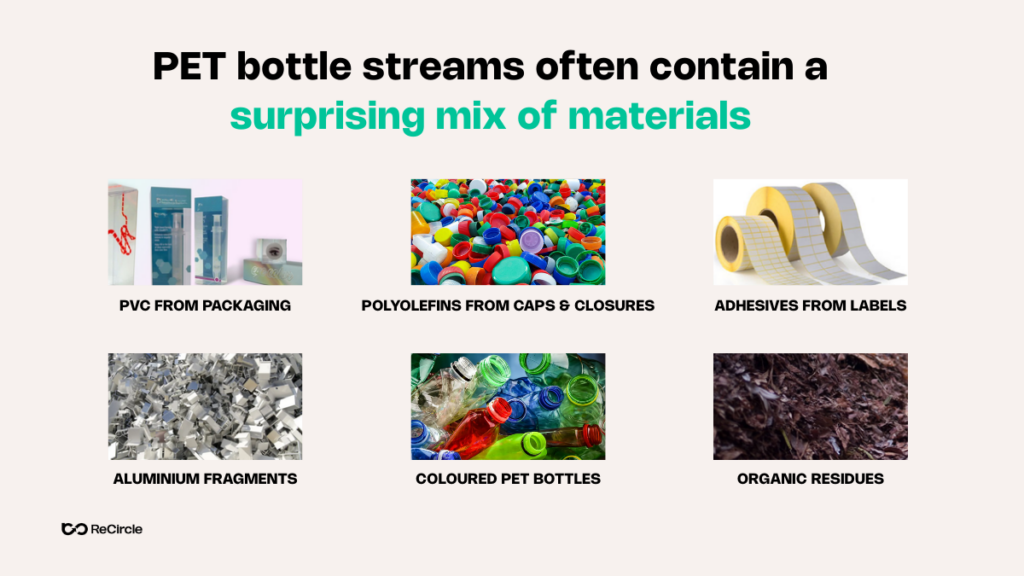
PET bottle streams often contain a surprising mix of materials:
- PVC from packaging
- polyolefins from caps and closures
- adhesives from labels
- aluminium fragments
- coloured PET bottles
- organic residues
Among these contaminants, PVC is particularly destructive. Even trace amounts can degrade PET during melting, causing discolouration, black specks and polymer instability.
This is why modern plastic recycling systems rely on several layers of separation:
- near-infrared optical sorting
- hot caustic washing systems
- density separation tanks
- metal detection
- multiple visual inspections
Each step removes a potential contaminant before the bottles become recycled plastic flakes.
Without these controls, the output may technically be recycled plastic, but it will struggle to meet food-grade requirements.
Quality isn’t an output. It’s a system.
This is where the conversation about rPET flakes becomes bigger than chemistry.
Quality does not begin inside the recycling reactor. It begins much earlier in the waste stream.
Feedstock collection, segregation, washing technology, drying systems and lab testing all influence the final performance of recycled PET.
When these elements operate independently, inconsistencies appear.
But when they are designed as a connected infrastructure, the results change.
The industry is gradually recognising that producing reliable recycled plastic flakes requires more than processing equipment. It requires a system built around material integrity.
Building Better Recycling Systems
At ReCircle, we see waste differently. Where others see discarded plastic, we see the beginning of a new supply chain. A resource waiting to be recovered.
Our approach is not simply to process waste. It is to build the infrastructure that allows materials to circulate again.
This means combining:
- structured collection networks
- advanced sorting and washing technology
- strict quality testing
- controlled drying and processing
The result is consistent, high-quality rPET flakes designed for demanding applications.
At ReCircle, our state-of-the-art recycling facility operates with stringent quality checks at every stage of production. The process is built to protect polymer quality, minimise contamination, and ensure the output meets strict BIS compliance targets.
Are you a packaging manufacturer, bottler, or converter looking to source high-quality food-grade rPET flakes for your production line?
Reach out to our recycling experts to learn how our recycling systems can deliver the consistency and compliance your packaging applications demand.
Frequently Asked Questions
Low IV can lead to:
- Weak bottle structures
- Processing instability
- Poor clarity in packaging
When rPET flakes with moisture are processed at high temperatures:
- Polymer chains break (hydrolysis)
- Intrinsic viscosity drops
- Material performance declines
The most critical contaminants include:
- PVC (highly damaging during melting)
- Polyolefins from caps and labels
- Adhesives and glue residues
- Metals and coloured PET
To qualify, they must:
- Maintain consistent intrinsic viscosity
- Have extremely low contamination levels
- Be processed through advanced decontamination systems
- Meet regulatory standards such as BIS compliance