The Hidden Problem Nobody Talks About in Recycled Plastic
Most conversations around recycling focus on a single metric: how much plastic gets collected.
Very few ask a more important question.
What is the quality of what gets recycled?
Because that is where the system quietly breaks.
On paper, PET recycling appears efficient. Bottles are collected, processed, and converted into rPET flakes that can be reused in manufacturing. In reality, most rPET produced today carries micro-contamination that limits its usability, reduces its value, and weakens the entire recycling ecosystem.
Caps fragment into microscopic particles. Labels embed chemically. Adhesives survive multiple wash cycles.
What looks like recycled plastic is often a compromised material.
According to research and circular design frameworks published by Ellen MacArthur Foundation, maintaining material quality across cycles is essential for true circularity. Recycling volume alone is not enough.
Understanding rPET Flakes: Where Theory Meets Reality
The recycling process is often presented as a clean, linear system:
Collection → Sorting → Shredding → Washing → Output as rPET flakes
In controlled environments, this works.
In real-world conditions, especially in India, the process behaves differently:
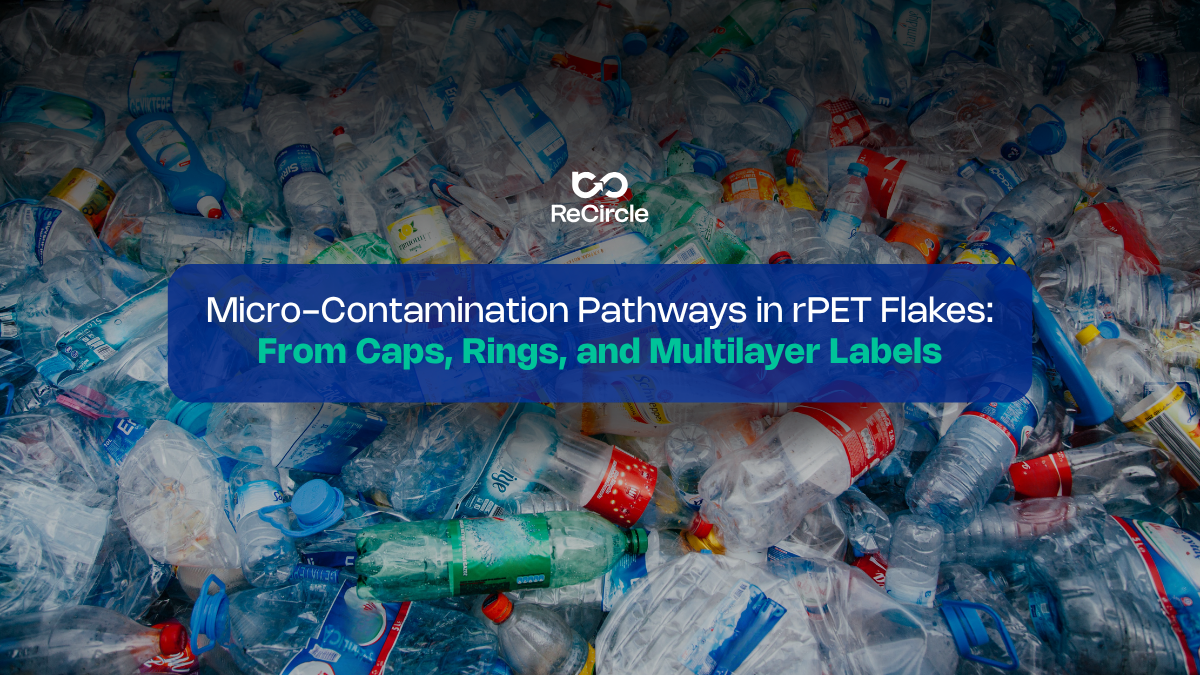
- Bottles arrive with caps, rings, and labels intact
- Sorting is largely manual and inconsistent
- Shredding breaks contaminants into smaller particles
- Washing removes surface impurities but not embedded residues
The result is that most rPET flakes contain both visible and invisible contamination.
This directly affects application potential.
High-purity rPET can be used in food-grade packaging or textiles.
Contaminated rPET flakes are typically diverted to lower-value uses such as strapping, fiber, or carpet backing.
This difference is not minor. Industry observations show a 20 to 40 percent drop in value between high-purity and contaminated material, a trend also discussed in plastics system analyses by the World Economic Forum.
The Three Primary Sources of Micro-Contamination
1. Caps: Fragmentation and Polymer Mismatch
Bottle caps are not made from PET. They are typically polypropylene or polyethylene.
During shredding:
- Caps do not separate cleanly
- They fragment into micro-particles
- These particles embed within rPET flakes
This creates a deeper issue than simple contamination.
Different polymers behave differently under heat. When PP or PE mixes with PET:
- Melting becomes inconsistent
- Structural weaknesses appear
- Final products lose strength and durability
In India, cap removal depends heavily on manual sorting at material recovery facilities. The effectiveness varies widely, which leads to inconsistent quality in rPET batches.
2. Rings: Designed for Strength, Not Recycling
Bottle rings are engineered to remain attached to the bottle neck.
That design works against recycling.
Instead of detaching:
- Rings break into smaller fragments
- These fragments remain embedded in rPET flakes
- Multiple polymers enter what should be a single-material stream
Unlike organic waste, these fragments:
- Do not dissolve
- Do not separate easily
- Persist throughout processing
They contribute to structural inconsistencies and reduce the overall quality of rPET.
Most recycling facilities in India do not have advanced separation systems capable of removing these particles effectively.
3. Multilayer Labels: The Most Persistent Contaminant
Labels are the most complex component on a plastic bottle.
A typical label consists of:
- Printed ink layers
- Plastic backing
- Adhesive bonding layer
- Sometimes metallic or foil elements
During processing:
- Labels fragment into fine particles
- Adhesives remain bonded
- Ink compounds embed into rPET flakes
According to material insights from PlasticsEurope, adhesives are specifically engineered to be durable, which makes them difficult to remove during recycling.
This creates multiple issues during reprocessing:
- Discoloration of material
- Odor generation
- Polymer degradation
- Clumping during melting
Unlike caps or rings, label contamination is both physical and chemical, making it significantly harder to address.
How Contamination Travels Through the System
Contamination does not originate at a single stage. It builds across the entire process.
Collection stage
Mixed waste with little segregation
Sorting stage
Manual removal removes some contaminants but not all
Shredding stage
Remaining contaminants fragment into smaller particles
Washing stage
Only partial removal of residues
Final output
rPET flakes with embedded contamination and inconsistent quality
Each stage reduces the probability of producing high-quality rPET.
The Role of India’s Informal Waste System
India’s recycling ecosystem depends heavily on informal networks:
- Waste pickers
- Kabadiwalas
- Aggregators
This system is efficient in terms of cost and coverage. It enables large-scale collection across urban and semi-urban areas.
However, it lacks standardization.
Sorting is done manually, often under time pressure and without formal training. As a result:
- Some material is well sorted
- Some carries high contamination
Research and field studies by Acumen Fund highlight that informal systems are essential for scale but introduce variability in quality.
This variability directly affects the consistency of rPET flakes in the market.
Invisible Contamination: The Chemical Layer
Even when rPET flakes appear clean, they often contain residual chemicals:
- Adhesive polymers
- Ink solvents
- Pigments
- Plasticizers
These compounds are not removed through standard washing.
During melting:
- Some compounds create odor
- Some cause discoloration
- Others weaken the polymer structure
This is one of the main reasons why food-grade rPET is rarely produced without blending with virgin PET.
Market Impact: Why Quality Struggles to Improve
The economics of rPET flakes are tied to purity:
- High purity leads to premium pricing
- Medium purity leads to moderate value
- Low purity leads to significant discounting
However, improving purity requires:
- Better sorting systems
- Advanced washing processes
- Higher operational costs
The price premium for cleaner material often does not justify these costs.
This creates a structural problem.
The system does not reward quality strongly enough.
As a result, most players optimize for volume instead of purity.
Why Processing Technology Alone Is Not Enough
Technologies such as:
- Optical sorting
- Advanced washing
- Density separation
can improve outcomes, but they do not eliminate contamination entirely.
Research from the OECD suggests that upstream interventions such as better product design and improved segregation are far more effective than downstream processing fixes.
The Real Solution: Design for Recycling
The most effective way to reduce contamination begins at the design stage.
A recyclable PET bottle should ideally include:
- Easily removable caps
- Single-layer labels
- Adhesives that weaken under heat
- No metallic coatings
Despite this, adoption remains limited because:
- Regulations are still evolving
- Redesign costs are high
- Branding considerations take priority
Until design improves, contamination will remain a systemic issue.
The Downcycling Reality
Most contaminated rPET flakes follow a downward lifecycle:
Bottle → Fiber → Carpet → Landfill
At this stage, the material exits the circular economy permanently.
This is not true recycling.
It is a delayed disposal.
Conclusion: The Real Bottleneck Is Quality, Not Collection
Recycling systems are often evaluated based on how much plastic is collected. That metric alone is incomplete.
The real measure of success is whether the material can be reused at the same level of value.
Today, contamination prevents that from happening at scale.
Improving rPET flakes quality requires:
- Better packaging design
- More consistent sorting systems
- Incentives for high-purity material
- Greater transparency across the supply chain
Without addressing these factors, recycling will continue to operate as a volume-driven system rather than a value-preserving one.
A Practical Perspective
If you are sourcing rPET or working within plastic waste systems, the goal should not be to find perfect material. That does not exist at scale today.
The real advantage lies in:
- Understanding where contamination originates
- Working with partners who actively mitigate it
- Prioritizing traceability over assumptions
Because in recycling, what you cannot see in the material often matters the most.
Where We See the Shift Happening
Across the value chain, one thing is becoming clear.
The conversation is slowly moving away from “how much plastic is recycled” to “how well it is recycled.”
That shift changes everything.
At ReCircle, we have seen firsthand how contamination is not just a processing problem, but a systems problem. It starts at design, flows through collection, and compounds during sorting and processing. Fixing it requires visibility across all these stages, not isolated interventions.
This is why we focus on building traceable, accountable waste supply chains where:
- material flows are visible
- quality can be assessed, not assumed
- and interventions can happen at the right stage
In practice, this means working closely with collection networks, aggregators, and processors to reduce contamination before it becomes irreversible.
Because once contamination enters rPET flakes, the options become limited and expensive.
Closing Thought
Recycling does not fail because we cannot collect enough plastic.
It fails when the material we recover is no longer usable at the same level of value.
Improving rPET quality is not about one better machine or one better process.
It is about aligning the entire system, from packaging design to final processing.
And the sooner that shift happens, the closer we get to a circular economy that actually works.
FAQs
1. What is the typical contamination level in rPET flakes in India?
Most rPET flakes contain between 2 percent and 8 percent contamination depending on collection and processing quality.
2. Can washing remove label adhesives completely?
No. Standard washing removes only a portion of adhesive residue. Complete removal is not achievable without damaging the polymer.
3. Where are contaminated rPET flakes typically used?
They are used in lower-value applications such as fiber, strapping, and carpet backing.
4. Which component contributes the most to contamination?
Multilayer labels, due to their chemical composition and adhesive bonding.
5. How does contamination affect pricing?
It can reduce the value of rPET flakes by 20 to 40 percent.
6. What is the most effective way to reduce contamination?
Removing caps and labels before shredding combined with better packaging design.
7. Will advanced recycling technologies solve this problem?
Not in the near term. Mechanical recycling will continue to dominate, making contamination control essential.