Most conversations around textiles and EPR, these days, start with Europe. But let’s just take a few steps back for this one and start somewhere much closer to home, like your brand’s local garment warehouse.
Somewhere right now, unsold stock is sitting in cartons, returned garments are being written off, and somewhere in the city, your product with your logo is lying in a dump yard.
Nobody tracks that part until the regulation forces you to.
Textile recycling is no longer a sustainability initiative you can opt in to or choose to ignore. It’s becoming a regulatory requirement, and brands risk noncompliance and reputational damage if they fail to ensure unwanted materials are properly disposed of.
So here’s the only question Fashion Brands should be asking:
If textile recycling becomes mandatory under EPR, are you operationally ready?
Use this blog as advice or a checklist, but if you can confidently say “yes” to most of these, you’re ahead.
If not, you’ve got work to do.
1. Can you map your post-consumer flow?
Most brands can map their supply chain to the retail store. After that, things get vague.
If textile recycling becomes mandatory, regulators won’t ask what your intention is. They will ask:
- How much textile waste did you collect?
- Who processed it?
- What percentage entered reuse, upcycling, or recycling streams?
- Can you show documentation?
A textile recycling system is not just a take-back campaign during Earth Month. It is:
- Verified collection partners
- Defined logistics routes
- Sorting facilities
- Authorised recyclers
- Measurable output data
If today you cannot trace your garments beyond the consumer wardrobe, that is your first gap.
And gaps become expensive when deadlines are announced.
2. Have you budgeted for textile EPR or are you hoping it’s minimal?
Textile EPR is not only about environmental compliance. It is cost allocation.
In Europe, brands pay fees based on the textile volume they introduce into the market. If textile recycling is regulated in India, similar financial structures are likely to emerge.
Which means:
- Collection has a cost.
- Sorting has a cost.
- Recycling has a cost.
- Reporting has a cost.
Forward-looking brands are already modelling textile recycling scenarios internally. They are calculating recovery cost per garment and understanding how that impacts pricing, sourcing, and margin structures.
Not to increase prices tomorrow, but to avoid margin shock later.
If your finance team has never run a textile EPR simulation, that’s another gap.
3. Are your textiles even designed for recycling?
This is where the conversation becomes slightly technical, but very real.
Textile recycling efficiency depends heavily on material simplicity.
Blended fabrics. Heavy embellishments. Mixed fibre constructions. Laminated components.
All of these reduce recyclability and increase processing complexity.
If your collections are built without considering end-of-life separation, your textile recycling costs will naturally be higher when compliance begins.
Global best practice is shifting toward design for recyclability:
- Reduce unnecessary fibre blends
- Simplify trims and attachments
- Improve material transparency
- Work with suppliers who understand circular design
Today’s design decisions directly influence your future compliance burden.
If your product team has never had a conversation about end-of-life recovery, that’s not a criticism.
It’s just early-stage awareness.
4. Is your data centralised or scattered?
Under textile EPR, reporting will not be optional. You will need to show:
- Units placed in the market
- Material composition
- Waste collected
- Waste processed
- Textile recycling outcomes
If this information currently sits across procurement spreadsheets, warehouse logs, and sustainability decks without integration, reporting will become operationally stressful.
Brands that prepare early integrate textile recycling tracking into ERP systems or sustainability dashboards before regulation forces urgency.
The worst time to build your first reporting framework is after compliance deadlines are published.
5. Who looks after textile recycling internally?
If your answer is “the sustainability team,” pause there. Textile recycling under EPR affects:
- Procurement
- Product design
- Logistics
- Finance
- Compliance
- Marketing
When responsibility is isolated, execution becomes fragmented.
Clear accountability should exist:
- One team driving readiness
- Defined roles across departments
- Internal training on regulatory expectations
EPR is not a campaign. It is a systems adjustment.
6. Are your consumer claims verifiable?
More than 60% of global consumers say sustainability influences their purchasing decisions. But the expectation has shifted from storytelling to proof.
If textile recycling becomes regulated, scrutiny of greenwashing increases automatically.
Brands that already have traceable textile recycling systems can communicate confidently.
Brands that rely on vague claims like “eco-friendly” or “conscious collection” without measurable recovery pathways will face reputational risk.
Transparent take-back programmes.
Clear recovery pathways.
Documented outcomes.
Communication should be supported by infrastructure, not the other way around.
7. Could you demonstrate readiness today?
Imagine an investor, regulator, or large retail partner asks:
- Can you show your textile recycling supply chain?
Can you provide recovery volumes in kilograms? - Can you identify your recycling partners?
- Can you quantify diversion from landfill?
Would your answer be structured or speculative? Textile recycling compliance will demand proof, and preparation gives you time to negotiate partnerships, stabilise costs, and build internal alignment.
Waiting compresses that timeline dramatically.
How ReCircle is supporting textile recycling readiness
Understanding textile recycling policy is one thing, but building the textile recycling infrastructure is another.
ReCircle works with fashion and textile brands to establish structured textile recycling systems before regulation makes them compulsory.
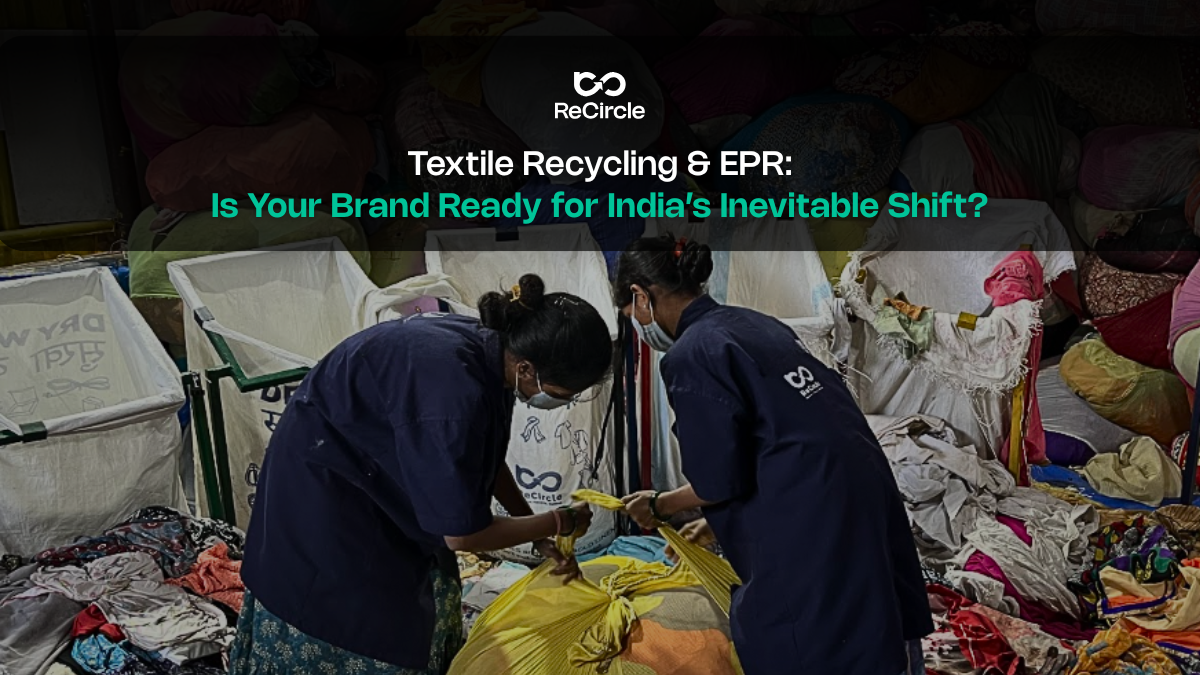
At our textile recovery facility in Mumbai, collected garments are sorted by trained Safai Saathis into defined pathways such as reuse, upcycling, or recycling. Each kilogram is tracked and categorised to ensure clarity in recycling outcomes.
Partner brands receive documented reporting on recovery volumes and material streams. This creates transparency not only for future textile EPR compliance but also for investor and consumer communication.
If your brand intends to build a traceable textile recycling supply chain rather than wait for regulation to dictate timelines, this is the stage where preparation makes the greatest difference.
If you want to strengthen your Textile Recycling supply chain and prepare for textile EPR before the rules force acceleration, now is the right time to begin.
Reach out to us to future-proof your business.