EPR for Plastic Waste usually becomes a priority for businesses at a particular moment. It often arises when a CPCB notice lands in the inbox, when an auditor flags non-compliance, or when a client or marketplace asks for proof of EPR registration before proceeding with business.
For many companies, plastic has always been part of everyday operations. It protects products, keeps logistics efficient, and supports large-scale distribution. What often goes unnoticed is what happens after that plastic leaves the customer’s hands. Over the years, regulations in India have shifted this responsibility back to businesses, making plastic waste management a shared obligation rather than a municipal one.
Today, if your company introduces plastic packaging into the Indian market, the responsibility does not stop at manufacturing or sales. It extends to the collection, recycling, and reporting of the plastic waste generated. This responsibility is defined under the Extended Producer Responsibility (EPR) framework.
In India, EPR registration is mandatory for producers, importers, brand owners, and manufacturers dealing with plastic packaging. It forms the foundation of the country’s plastic waste management framework and is closely monitored by the Central Pollution Control Board.
If you are a producer, importer, brand owner, or manufacturer, this guide explains how EPR for Plastic Waste registration works in India, who must comply, and what the process entails in practice.
What Is Extended Producer Responsibility?
Extended Producer Responsibility is a policy approach that makes businesses responsible for the plastic waste they generate.
Put simply, if your company places plastic packaging or plastic products in the market, you must also ensure that an equivalent quantity of plastic waste is collected, processed, and recycled responsibly.
In India, EPR for Plastic Waste is implemented under the Plastic Waste Management Rules, 2016, and enforced by the Central Pollution Control Board (CPCB).
India generates approximately 3.5 million tonnes of plastic waste every year, according to CPCB estimates. Managing this volume of waste cannot be left to municipalities alone. Businesses that benefit from plastic must also take responsibility for its end-of-life management.
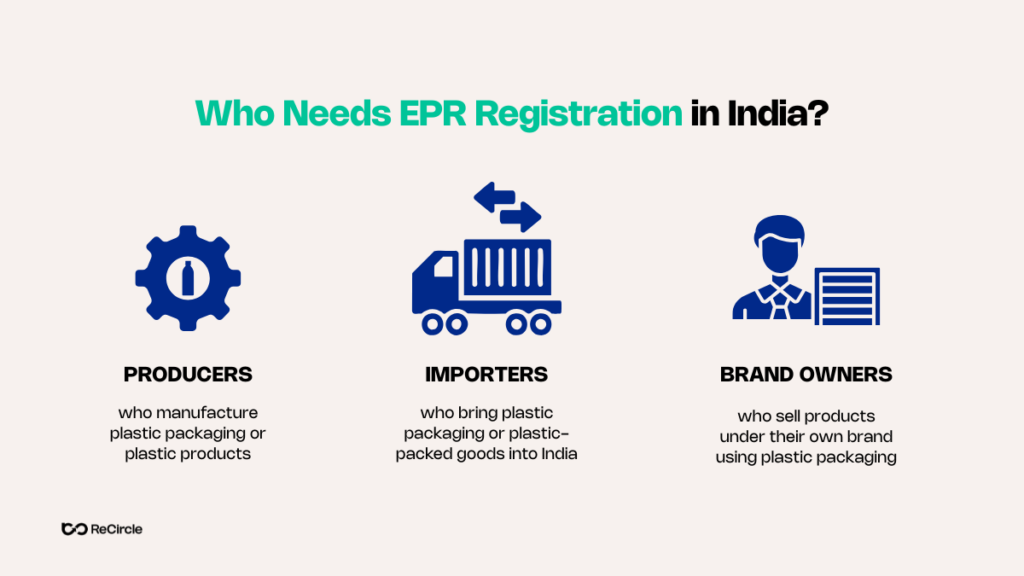
Who Needs EPR Registration in India?
This is where confusion often starts.
You need EPR registration for plastic waste if you fall into any of the following PIBO categories:
- Producers who manufacture plastic packaging or plastic products
- Importers who bring plastic packaging or plastic-packed goods into India
- Brand Owners who sell products under their own brand using plastic packaging
If plastic is used anywhere in your packaging, EPR for Plastic Waste applies to you, even if manufacturing is outsourced or plastic is only a small component of your product.
If plastic enters the Indian market as a result of your business activities, you are responsible under the EPR India guidelines.
Why EPR for Plastic Waste is More Than Just a Certificate
Many businesses view EPR registration as a one-time compliance checkbox. Complete the form, upload the documents, obtain the certificate, and proceed.
In reality, that approach often leads to trouble.
EPR for Plastic Waste is not a one-time approval. It’s an ongoing compliance framework. Once registered, businesses are required to:
- Meet annual plastic waste collection targets.
- Work only with CPCB-authorised recyclers and processors.
- Maintain verifiable proof of recycling and waste processing.
- File periodic returns on the CPCB EPR portal.
Non-compliance can result in penalties under the Environment Protection Act, cancellation of EPR registration, and even restrictions on sales. This is why many companies rely on professional EPR compliance services instead of managing everything internally.
Understanding the Registration Process Step by Step
Let’s break down the registration process for EPR for plastic waste into clear, logical steps.
Step 1: Identify Your Correct PIBO Category
Before logging into the portal, you must clearly identify whether you are a producer, importer, or brand owner. This classification determines:
- Your compliance obligations
- Your reporting structure
- Your annual EPR targets
Incorrect categorisation is one of the most common reasons applications are rejected.
Step 2: Register on the CPCB EPR Portal
All EPR for Plastic Waste registrations are completed online through the CPCB EPR portal. You’ll need:
- Company legal details
- Registered office address
- States of operation
- Authorised signatory information
These details must match your GST and incorporation records exactly.
Step 3: Prepare Your Documents Carefully
Documentation errors cause most delays. Typically required documents include:
- PAN and GST certificates
- CIN or incorporation certificate
- Aadhaar and PAN of the authorised signatory
- Import Export Code (for importers)
- Product and packaging details
- Process flow diagrams (for producers)
Even minor mismatches can pause your application.
Step 4: Submit Your Plastic Waste Management Plan
This is the core of EPR for Plastic Waste compliance.
Your plan must clearly explain:
- The quantity of plastic introduced into the market
- The amount of plastic waste to be collected
- Authorised recyclers you will work with
- How recycling and reporting will be tracked
Generic or vague plans are often flagged by CPCB, which is why expert guidance makes a real difference here.
Step 5: Pay the Fee and Submit
Fees vary based on business category and scale. Once paid, you receive an acknowledgement, and the application moves into review.
Step 6: CPCB Review and Approval
CPCB may raise queries or request clarifications. Timely and accurate responses help avoid delays. Upon approval, your EPR registration certificate is issued digitally.
What Happens After EPR for Plastic Waste Registration?
Registration is only the beginning. After approval, businesses must:
- Meet annual EPR targets.
- Track plastic waste across states.
- Maintain recycler agreements.
- Upload recycling proof.
- File regular returns.
This ongoing responsibility is why many companies work with dedicated EPR compliance partners in India.
Common Challenges in EPR for Plastic Waste Compliance
In practice, businesses often struggle with:
- Identifying authorised recyclers.
- Understanding CPCB portal reporting.
- Missed deadlines or incorrect filings.
- Lack of traceability in waste collection.
- Frequent regulatory updates.
Without proper EPR compliance support, these gaps usually surface during audits.
Why Choosing the Right EPR Partner Makes All the Difference
EPR works only when plastic waste is genuinely collected and recycled—not just reported on paper.
A reliable EPR partner helps you:
- Design a compliant plastic waste strategy.
- Connect with verified recyclers.
- Track waste digitally.
- Stay audit-ready.
- Adapt to regulatory changes.
This is why businesses look for an experienced plastic EPR provider in India, not just a consultant.
How ReCircle Supports EPR for Plastic Waste Compliance
ReCircle operates at the intersection of compliance, technology, and on-ground waste management.
As one of the trusted waste management companies in Mumbai with a national footprint, ReCircle supports:
- EPR for Plastic Waste registration
- Plastic waste collection and aggregation
- Authorised recycling and processing
- Digital traceability and reporting
- End-to-end compliance management
Their systems ensure plastic waste is actually collected and recycled—not merely adjusted on spreadsheets.
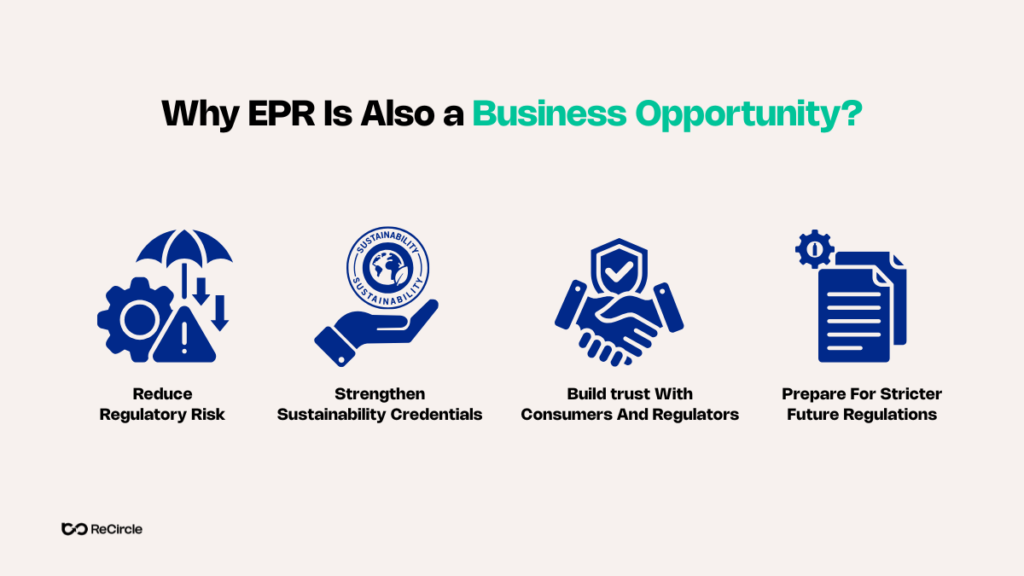
Why EPR Is Also a Business Opportunity
When implemented correctly, EPR for Plastic Waste goes beyond compliance. It helps businesses:
- Reduce regulatory risk
- Strengthen sustainability credentials
- Build trust with consumers and regulators
- Prepare for stricter future regulations
As plastic regulations tighten globally, robust EPR systems are quickly becoming a competitive advantage.
Turning EPR for Plastic Waste Compliance Into Long-Term Value
EPR for Plastic Waste registration is no longer optional in India. It is a legal requirement and a business reality.
By understanding extended producer responsibility, following the correct registration process, and working with the right EPR partners, businesses can transform a complex obligation into a structured, future-ready system.
If your business uses plastic packaging, the real question isn’t whether you need EPR; it’s whether your EPR system can stand up to scrutiny tomorrow.
Click here to connect with our EPR Experts for a smooth end-to-end registration process.