In the traditional linear economy, the lifecycle of a plastic bottle was a straight line to a landfill. Today, that line has been forcibly bent into a circle by the Government of India. As of April 2026, the Polluter Pays principle has transitioned from a boardroom discussion to a mandatory line item in every FMCG balance sheet with the full implementation of the Solid Waste Management (SWM) Rules, 2026
For Brand Owners, Importers, and Plastic Waste Processors (PWPs), understanding the intersection of regulation and material science is no longer optional; it is the key to business continuity. At the heart of this transition is one specific resource: rPET Flakes.
1. The 2026 Compliance Cliff
The plastic waste crisis is no longer just an environmental headline; it is a supply chain bottleneck. For decades, the solution to plastic waste was out of sight, out of mind. However, the shift toward circular packaging has moved from a nice-to-have CSR project to a must-have legal framework.
Governments worldwide, led by India’s Ministry of Environment, Forest and Climate Change (MoEFCC), are pushing for mandatory recycled content. rPET is now mandatory. According to recent industry benchmarks, meeting these targets could reduce GHG emissions by 4.5 million tonnes of CO₂-eq annually [Source: India’s Plastic Waste Rules 2025/26].
2. What are rPET and rPET Flakes?
To navigate this market, we must define our terms with technical precision.
- rPET (recycled Polyethylene Terephthalate):
The polymer recovered from post-consumer PET packaging.
- rPET Flakes (The Intermediate Form):
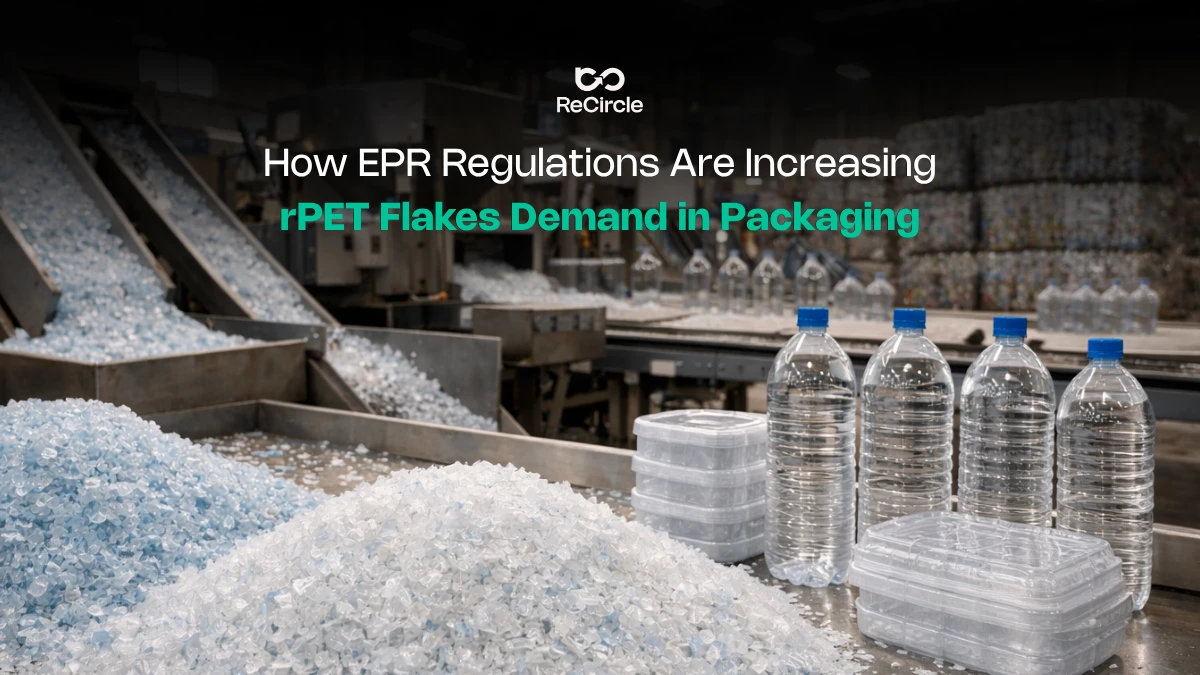
These are the raw flakes flakes chips created after bottles are sorted, cleaned, and shredded.
- rPET Pellets (The Manufacturing-Ready Form):
Produced by melting flakes and extruding them into uniform beads.
In 2026, the quality of the flake determines the success of the pellet. High-end packaging requires flakes with stable Intrinsic Viscosity (IV) and minimal PVC contamination to meet the stringent standards of rPET buyers [Source: JB Ecotex rPET Flake Guide 2026].
3. Why the Packaging Industry is Shifting to rPET
The shift is driven by three non-negotiable forces:
- ESG and Sustainability Goals: Swapping virgin plastic for rPET flakes slashes carbon emissions significantly.
- Consumer Demand: Urban Indian consumers now view recycled content as a badge of brand honesty.
- Cost Stabilization: While virgin plastic is at the mercy of volatile global oil prices exacerbated by current geopolitical uncertainties, the rPET market is maturing into a localized, stable commodity [Source: IANS / APR Bharat March 2026].
4. Role of EPR Regulations in Driving Demand
Extended Producer Responsibility (EPR) is the invisible hand reshaping the market. It mandates that any company introducing plastic packaging is responsible for its end-of-life management.
On January 19, 2026, the MoEFCC issued a landmark notification withdrawing the provision that allowed companies to use End-of-Life (EOL) disposal certificates (like incineration) to meet recycling targets. You must now recycle into new material [Source: Aleph India / MoEFCC Notification 2026].
5. Government Mandates on Recycled Content (India Focus)
India’s PWM Rules have set clear, aggressive year-on-year targets for recycled plastic content:
- FY 2025-2026: Category I (Rigid Plastic) must contain a minimum of 30% recycled content.
- FY 2026-2027: This increases to 40%.
- FY 2028-2029: The target peaks at 60% [Source: ReCircle PWM 2025 Amendments].
6. How EPR Creates a Supply-Demand Loop
EPR turns waste into a resource through a documented loop:
- Collection: Brands pay for recovery via EPR certificates.
- Recycling: Waste is processed into high-grade rPET flakes.
- Sourcing: Brands purchase these flakes to meet their mandatory 30% content target.
7. Industries Driving rPET Demand
- Beverage & Food: Driven by the FSSAI’s recent authorization of 17 rPET plants, unlocking 3 lakh tonnes of capacity for food-contact packaging [Source: Indian Chemical News, March 16, 2026].
- Personal Care: Shifting toward 100% rPET bottles to reduce plastic tax liabilities.
8. Challenges in rPET Supply
- Infrastructure: India needs more super-clean washing lines to meet the 40% mandate for 2026-27.
- Quality: Mixed-plastic contamination remains the primary barrier to high-yield recycling.
- Price: Demand is currently outstripping supply, creating a scarcity premium for certified food-grade flakes.
9. How Companies Can Secure rPET Supply
- EPR Partnerships: Collaborate with experts who manage the supply chain from the Safai Saathi (waste picker) to the factory floor.
- Traceability: Utilize digital platforms to provide an immutable audit trail for the CPCB.
10. Future Outlook: rPET as the Packaging Standard
The global 100% rPET bottle market is valued at $3.5 billion in 2026 and is projected to reach $7.9 billion by 2036 [Source: Future Market Insights 2026 Report]. Circularity is no longer the alternative ; it is the default.
The Circular Advantage
The demand for rPET flakes is not a trend; it is the new foundation of the packaging industry. Companies that act today to secure their supply chains will be the ones that survive the regulatory tightening of 2028.
Partner with ReCircle to ensure compliant and traceable rPET sourcing.
FAQs
1. What is the difference between rPET flakes and pellets?
Flakes are shredded, cleaned post-consumer bottles. Pellets are the refined resin made by melting these flakes. In 2026, manufacturers increasingly buy high-quality flakes to ensure they control the Intrinsic Viscosity (IV) of their final product [Source: JB Ecotex 2026].
2. Can I use incineration to meet my 2026 recycling targets?
No. The January 19, 2026, MoEFCC notification explicitly states that End-of-Life (EOL) disposal certificates cannot be used to offset recycling obligations [Source: Aleph India 2026].
3. Is 30% recycled content mandatory for all packaging?
For FY 2025-26, the 30% mandate applies to Category I (Rigid Plastic). Category II (Flexible) has a 10% target, while Category III (Multi-layered) is at 5% [Source: ReCircle 2025 Amendments].
4. How many food-grade rPET plants are authorized in India?
As of March 16, 2026, the FSSAI has authorized 17 plants, providing a combined capacity of approximately 3 lakh tonnes [Source: Indian Chemical News 2026].
5. What is the penalty for failing to meet EPR targets?
Non-compliance results in Environmental Compensation (EC). Fines can reach ₹5,000 for institutions, and missed targets are carried forward, compounding your obligations for the following year [Source: UKHI Plastic Rules Guide 2026].
6. Why is traceability through QR codes mandatory now?
Effective July 1, 2025, every plastic package must display a QR/barcode linked to its EPR registration. This prevents greenwashing and ensures that every batch of rPET flakes is genuinely post-consumer [Source: UKHI 2026].
7. How does ReCircle ensure high-quality flake output?
By formalizing the informal sector. We work with over 3,600 Safai Saathis to ensure source-level segregation, which prevents the contamination that typically degrades rPET flake quality [Source: ReCircle FY 2024-25 Impact Report].