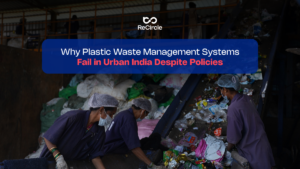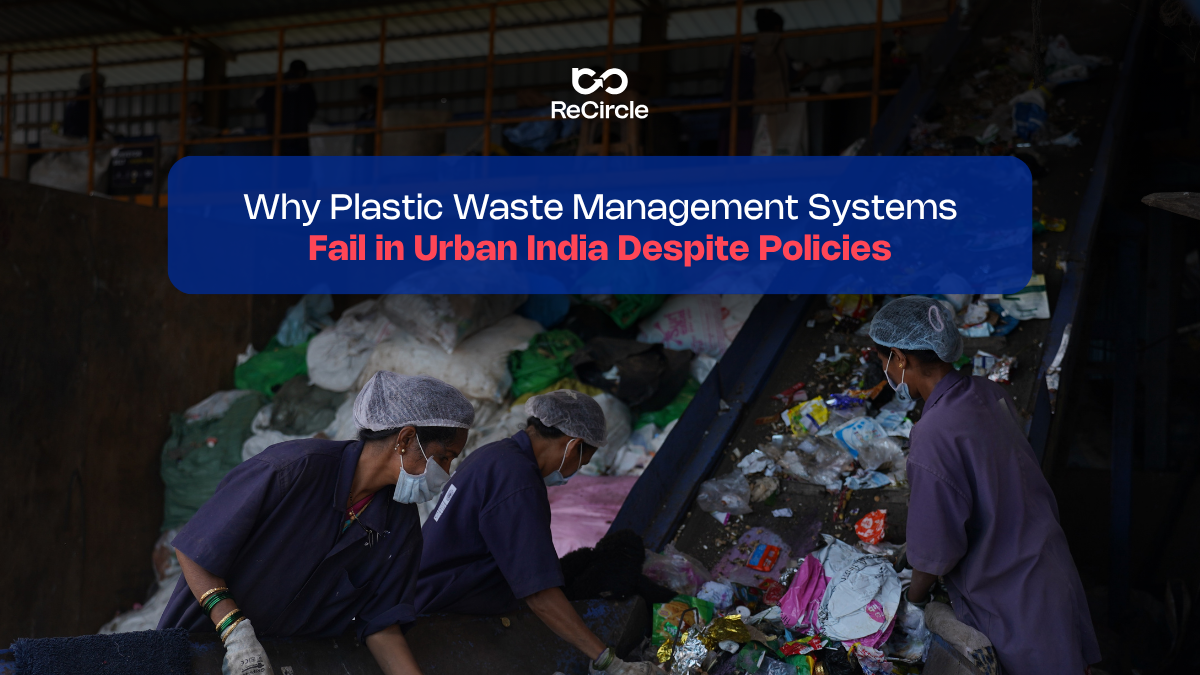
The Gap Between Policy Intent and Ground Reality
India does not lack policies for plastic waste management.
In fact, the country has one of the more structured regulatory frameworks through the Plastic Waste Management Rules, Extended Producer Responsibility mandates, and recent amendments focused on recycled content.
Yet, across cities, plastic waste continues to:
- accumulate in landfills
- leak into rivers and drains
- enter informal and unregulated processing systems
This is not because policy is absent.
It is because systems on the ground do not operate the way policies assume they do.
Understanding why plastic waste management fails requires looking beyond regulation and into execution, incentives, and infrastructure.
The Scale of the Problem
India generates approximately 3.4 to 3.5 million tonnes of plastic waste annually, with urban areas contributing the majority. Estimates and sector analyses from the Central Pollution Control Board highlight a critical gap: only about 30 to 40 percent of plastic waste is formally processed. The remaining 60 percent is either unmanaged, informally handled, or lost to the environment.
This is not a marginal inefficiency. It is a systemic breakdown.
Why Collection Systems Fail
Collection is the foundation of any plastic waste management system.
If waste is not collected properly, every downstream process becomes irrelevant.
1. Source Segregation Rarely Happens
Policies assume households segregate waste into dry and wet categories.
In reality:
- Awareness is inconsistent
- Infrastructure is limited
- Behavioral compliance is low
Even where segregation happens, it often collapses during collection.
This problem is widely acknowledged in urban waste studies, including findings referenced by NITI Aayog
The result:
- Plastic gets contaminated with organic waste
- Material quality drops immediately
- Recycling becomes more expensive and less viable
2. Collection Coverage Is Incomplete
Urban systems do not reach all waste sources.
Gaps exist in:
- Informal settlements
- High-density commercial areas
- Street markets
- Construction zones
This leads to:
- Uncollected waste
- Informal dumping
- Environmental leakage
Even cities with high reported collection efficiency often have uneven coverage across different zones.
3. Collection Frequency Is Misaligned
Waste is generated daily.
Collection is often irregular.
This mismatch leads to:
- Waste accumulation
- Degradation due to exposure
- Increased contamination
During monsoons or peak seasons, these inefficiencies amplify.
Why Sorting Systems Break Down
- Even when waste reaches Material Recovery Facilities, plastic waste management faces another significant bottleneck. The gap between what arrives at a facility and what is recovered from it is where much of the system’s value is quietly lost.
- Manual sorting, which remains the primary method across most Indian facilities, is inherently limited by human capacity. Workers handle large volumes of mixed material, often under difficult conditions, without standardised training or consistent guidance on what to separate and to what degree of purity. Sorting accuracy drops over long shifts. Material that should be recovered as clean plastic is classified as reject. And material that should be rejected as contaminated passes through as recyclable.
- Advanced sorting technologies exist that can address many of these limitations, using near-infrared sensors, optical sorters, and AI-driven classification systems to identify and separate polymer types accurately at high speeds. But adoption remains low across Indian facilities, primarily because capital costs are high, maintenance requires technical expertise that is not always available locally, and the inconsistent quality of incoming material makes it difficult to calibrate and run these systems efficiently. Without consistent input quality, even well-designed technology underperforms.
- The infrastructure constraints compound these issues further. Many Material Recovery Facilities are undersized relative to the volumes they receive, poorly maintained due to funding constraints, and operating without the capacity to handle peak input periods. When input exceeds capacity, sorting quality declines, material backlogs increase, and contamination spreads through the facility.
The Recycling Capacity Mismatch
Even if collection and sorting were perfect, plastic waste management would still face a major structural constraint. Recycling capacity is unevenly distributed, concentrated in states like Maharashtra, Gujarat, and Tamil Nadu while many regions lack local infrastructure entirely.
This creates several cascading issues:
- High transportation costs — moving waste across states reduces the economic viability of recycling lower-value materials
- Material degradation — plastic stored for extended periods waiting for transport loses quality over time
- Informal processing — in the absence of formal capacity, informal processors take over, operating without environmental controls, traceability, or quality standards
Contamination and Its Economic Impact
Contamination is one of the most critical barriers in plastic waste management.
Sources include:
- Food residue
- Mixed materials
- Labels and adhesives
- Environmental exposure
Once contaminated:
- Processing costs increase
- Material value drops
- Recycling becomes less viable
This creates a cycle:
Low-quality input → low-value output → low incentive to improve systems
As highlighted in global plastic system research by the OECD material quality is a key determinant of circularity outcomes.
Why Awareness Campaigns Fall Short
Cities invest heavily in awareness campaigns. Yet behaviour changes slowly. Reasons include:
- Lack of incentives — no direct benefit for segregation
- System mismatch — segregated waste often gets mixed again during collection
- Weak enforcement — penalties for non-compliance are rarely applied
This creates a trust gap. People stop participating when systems do not reinforce behaviour. A household that segregates carefully and then watches a single collection vehicle mix everything together has a rational reason to stop making the effort.
The Problem of Informal Dumping
A significant portion of plastic waste never enters formal systems. Dumping occurs in open land, drains, rivers, and coastal areas. The primary reasons are lack of accessible collection points, the cost of proper disposal, and the ease of informal handling.
Environmental consequences include microplastic pollution entering water systems, contamination of soil and groundwater near dump sites, and damage to aquatic ecosystems downstream. The material that is dumped informally represents not just an environmental failure but a resource loss. Every tonne that enters a drain or a landfill is feedstock that never becomes recycled plastic.
Weak Monitoring and Enforcement
Policies exist, but enforcement remains inconsistent.
Challenges include:
- Limited manpower
- Lack of monitoring tools
- Administrative inefficiencies
- Overlapping responsibilities
According to multiple governance studies, enforcement gaps are a major reason why plastic waste management policies fail to translate into outcomes.
The Role of Illegal Processing
Where formal systems fail, informal and illegal operations fill the gap.
These operations:
- Accept contaminated waste
- Operate without environmental controls
- Burn or improperly process plastic
This leads to:
- Air pollution
- Soil contamination
- Health risks for nearby communities
The Core Issue: Misaligned Incentives
At its core, plastic waste management fails because incentives are misaligned.
- Households have no strong incentive to segregate
- Collectors are paid for volume, not quality
- Facilities are not rewarded for precision
- Recyclers prioritize cost over purity
- Producers focus on compliance, not outcomes
The system optimizes for:
volume over value
What Actually Works
Some Indian cities show better outcomes. Indore’s model of consistent door-to-door collection, strict source segregation enforcement, and decentralised processing infrastructure is the most cited example nationally. Common factors across cities that perform better include strong enforcement with visible consequences, genuine community involvement rather than passive awareness campaigns, decentralised systems that reduce transport and storage losses, and real-time monitoring that makes problems visible before they compound.
These examples demonstrate that plastic waste management can work, but only when systems align with real-world behaviour and economic incentives across every stage of the chain.
Conclusion: Policy Is Not the Problem. Systems Are.
India does not need more policies for plastic waste management. It needs better alignment between policy and execution. The system fails because infrastructure is uneven, incentives are misaligned, enforcement is weak, and quality is consistently undervalued. Until these are addressed, leakage will continue despite regulation.
Where We See the Shift Happening
There is a clear shift underway. The conversation around plastic waste management is moving beyond collection metrics toward something far more meaningful: verified outcomes and material quality. This shift is not driven by policy alone. It is being pushed by the limitations of the current system.
Across cities, it is becoming evident that:
- Waste is being collected, but not consistently processed
- Material is being moved, but not always recovered
- Compliance is being reported, but not always verified
Bridging this gap requires more than infrastructure. It requires visibility across the entire waste value chain.
How We Approach This Problem
At ReCircle, we approach plastic waste management as a system, not a set of isolated activities. Because the breakdown rarely happens at one stage. It happens across multiple points simultaneously.
From what we see on the ground, contamination often begins at collection. Value is lost during sorting. Traceability disappears during aggregation. And by the time material reaches recyclers, options are already limited.
This is why our focus is not just on moving waste, but on understanding how it moves. In practice, that means working directly with collection networks to improve input quality, building traceability across aggregation and processing stages, and enabling transparency into where material originates and where it ends up.
Because without that visibility, even well-designed systems operate on assumptions. And in waste management, assumptions are where inefficiencies scale fastest.
Why This Matters More Going Forward
As regulations evolve and expectations increase, the system is being pushed toward higher transparency, better verification, and stronger accountability. This is especially relevant as plastic waste management shifts toward recycled content requirements, traceable supply chains, and measurable environmental outcomes.
In this environment, simply collecting waste will not be enough. The ability to track, verify, and improve material quality across the chain will become the defining factor in separating operators who are genuinely contributing to circularity from those who are meeting a compliance number and nothing more.
Closing Thought
India’s plastic waste challenge is not just a matter of collection. It is fundamentally a question of how well the entire system is aligned. Effective plastic waste management depends on every stage of the value chain working in coordination with the others, rather than operating in isolation. The future of the sector will not be defined by simply increasing collection volumes, but by building more integrated and efficient systems. Organisations that recognise and act on this shift early will be the ones that ultimately shape how circularity is implemented in practice.
FAQs
1. What percentage of plastic waste is formally managed in India?
Approximately 30 to 40 percent is formally processed.
2. Why does source segregation fail?
Due to lack of incentives, infrastructure, and enforcement.
3. What is the biggest bottleneck in plastic waste management?
Collection and sorting inefficiencies.
4. Why is recycling capacity uneven?
It is concentrated in a few industrial states.
5. What role does contamination play?
It reduces material value and recyclability.
6. Why don’t awareness campaigns work effectively?
Because systems do not reinforce behavior.
7. What is needed to improve outcomes?
Better incentives, infrastructure, traceability, and enforcement.