The Gap Between Regulation and Reality in Plastic Waste Management
India’s EPR for plastic waste is often described as one of the most comprehensive regulatory frameworks for managing post-consumer plastic.
On paper, it is structured, measurable, and enforceable.
Producers declare plastic usage. Targets are assigned. Recycling must be ensured. Compliance is reported.
But what is rarely discussed is this:
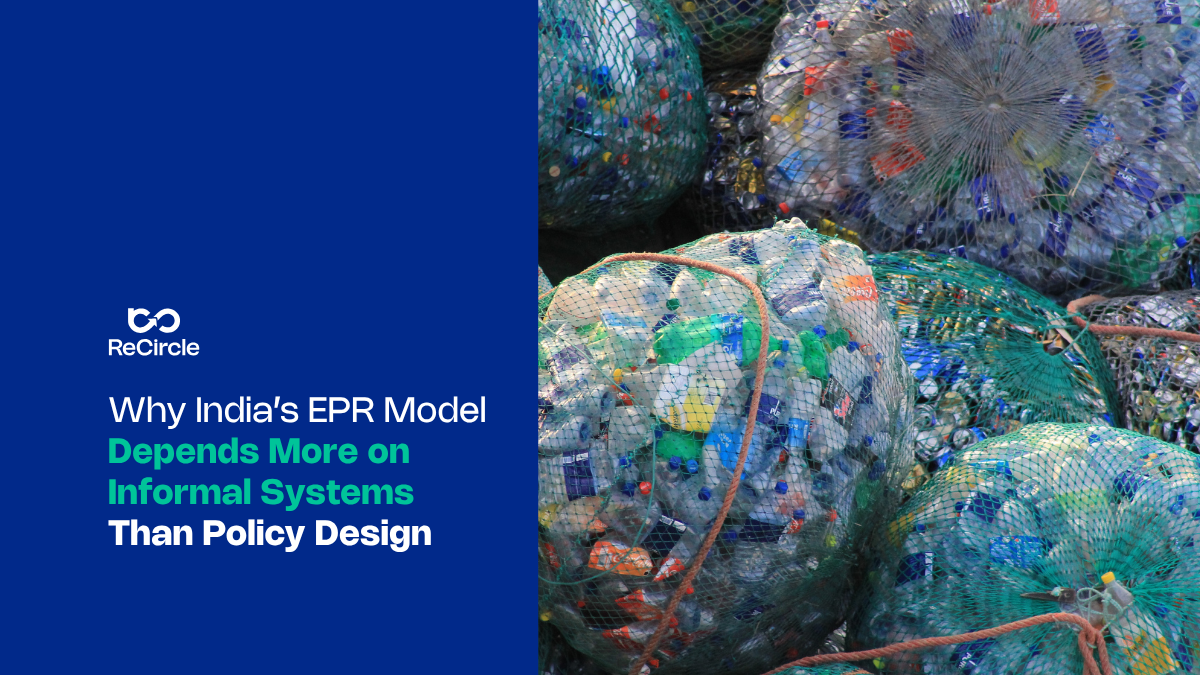
The success of EPR India does not come from the policy itself. It comes from a parallel system that the policy depends on but does not fully control.
That system is India’s informal waste economy.
Understanding this gap between policy intent and operational reality is critical for anyone working in plastic waste management today.
What EPR Was Designed to Do
India introduced Extended Producer Responsibility through the Plastic Waste Management Rules, 2016, with subsequent amendments strengthening compliance requirements.
The framework requires:
- Producers, importers, and brand owners to register
- Declaration of plastic introduced into the market
- Recovery and recycling of at least 70% of that plastic (as per phased EPR targets, subject to increase over time)
- Compliance through direct operations or credit mechanisms
The official guidelines can be reviewed via the Central Pollution Control Board
The objective is clear.
Shift responsibility from municipalities to producers and create a closed-loop system.
In theory, this creates accountability.
In practice, it creates dependency.
The Informal Backbone of EPR India
India’s recycling system is not built on centralised infrastructure. It is built on distributed human networks, and this is not an accident of circumstance. It is the structural reality that makes the system function at all.
Multiple studies estimate that over 60% of recyclable waste in India is collected by informal workers. This ecosystem includes waste pickers known as Safai Saathis, kabadiwalas, and local traders and aggregators who move material from households and streets into the broader recycling supply chain. Together, they perform last-mile collection, primary sorting, and material aggregation at a scale and cost that no municipal system has been able to replicate.
The reason informal networks dominate is straightforward. Municipal collection systems are underfunded, geographically limited, and structurally unable to serve the density and diversity of waste streams across Indian cities. Informal workers fill that gap not because they are incentivised by policy, but because the economics of material recovery sustain them. Without them, EPR for plastic waste would not function at the scale regulators assume it does.
How the System Actually Works
To understand EPR India, it is important to follow the real flow of material and money.
How the System Actually Works
To understand EPR India, it is important to follow the real flow of material and money.
Step 1: Producers Purchase Compliance Brands are required to meet recycling targets. Most do not collect waste directly due to cost and complexity. Instead, they purchase EPR credits.
Step 2: Recyclers Source Material Recyclers must demonstrate that plastic has been collected and processed. They source this material through aggregators.
Step 3: Informal Networks Supply the System Aggregators depend on informal workers for collection. These workers collect waste daily, sort material manually, and sell it into the system.
Step 4: Payments Cascade Down Money flows from producers to recyclers to aggregators to waste pickers. This flow sustains EPR India. If this chain weakens, the entire system slows down.
The Measurement Problem
One of the least discussed issues in epr for plastic waste is how performance is measured.
The system relies heavily on reported data rather than verified ground truth.
Recyclers submit:
- Collection volumes
- Processing records
- Compliance reports
Verification mechanisms are limited.
According to OECD research on EPR systems
Data transparency and traceability are among the biggest global challenges in EPR implementation.
In India, this challenge is amplified by:
- Informal documentation practices
- Fragmented supply chains
- Limited audit infrastructure
This creates gaps such as:
- Over-reporting of material
- Quality misrepresentation
- Limited visibility for brands
The Central Role of Informal Workers
At the core of EPR India are individuals who are not formally integrated into policy frameworks. A typical waste picker collects waste from streets and households, sorts materials manually, sells recyclables to local traders, and earns variable daily income tied entirely to material prices.
Their incentives are market-driven. Better material earns higher prices. Clean, sorted plastic has higher value than mixed or contaminated material. This creates partial alignment with EPR for plastic waste objectives, but not full alignment. Waste pickers are not directly incentivised by compliance structures. They are not formally recognised within EPR policy as service providers. Their contribution to the system is enormous and largely undocumented.
Yet without them, collection efficiency would collapse. The informal worker is simultaneously the most essential participant in India’s EPR system and the least protected by it.
Why Formalization Is More Complex Than It Appears
A common policy recommendation is to formalize the informal sector.
In reality, this is difficult.
Formalization introduces:
- Fixed wages
- Compliance costs
- Administrative overhead
- Reduced operational flexibility
For workers:
- Autonomy decreases
- Earnings may not improve
For businesses:
- Costs increase significantly
This is why EPR India operates by integrating informal systems rather than replacing them.
Credit Markets and Structural Limitations
The credit mechanism within EPR for plastic waste is designed for flexibility. However, it introduces systemic inefficiencies.
- Quality blindness: Credits represent quantity, not quality. Low-grade and high-grade materials are often treated similarly
- Verification gaps: Audit systems are inconsistent. Self-reporting dominates
- Price disconnection: Credit pricing is often disconnected from actual collection and recycling costs
This creates a system where compliance can be achieved on paper while environmental outcomes vary significantly in practice.
Regional Variation Across India
EPR is a national framework, but implementation varies significantly.
For example:
- Tamil Nadu and Kerala show stronger systems due to better infrastructure
- Maharashtra and Gujarat benefit from industrial recycling capacity
- Several northern states face gaps in both infrastructure and enforcement
These differences arise due to:
- Variability in informal network organization
- Differences in recycling capacity
- Governance and enforcement strength
As a result, EPR India operates as a decentralized system shaped by regional realities.
The Shift Toward Recycled Content
Recent regulatory changes are shifting EPR for plastic waste toward a new direction. The focus is moving from collection volume to verified recycled content. This aligns with global policy thinking around circularity and introduces traceability requirements, quality accountability, and supply chain transparency into a system that was previously measured only on tonnage.
What this means in practice is significant. Informal systems that were sufficient for volume-based compliance are no longer sufficient for content-based compliance. Documentation becomes critical. Quality becomes non-negotiable. The plastic that enters a recycling facility matters as much as the volume that leaves it.
The Role of Digital Traceability
To address these gaps, digital systems are emerging that enable tracking of material flows, verification of collection and processing, reduction of fraud, and transparency for brands purchasing EPR credits.
However, adoption remains limited due to cost barriers, usability challenges in informal settings, and the absence of strong regulatory incentives to adopt systems that increase accountability. Technology can enable trust in the supply chain, but it cannot replace the underlying system alignment that makes that trust credible.
Conclusion: The System Works Because of What It Was Not Designed For
India’s EPR for plastic waste is often evaluated based on policy design.
But its real strength lies elsewhere.
It works because it leverages an existing informal ecosystem that:
- operates at low cost
- adapts quickly
- achieves scale
The challenge ahead is not to replace this system.
It is to strengthen it while improving transparency, quality, and accountability.
Where We See the Shift Happening
The conversation around EPR India is changing. It is moving from compliance-driven thinking to credibility-driven systems. At ReCircle, we see this transition clearly.
EPR is no longer just about meeting targets. It is about proving how those targets are achieved. This requires visibility across the supply chain, traceability of material flows, and accountability at every stage. In practice, this means working closely with informal collection networks, aggregators, and processors to ensure that material is genuinely recovered, quality is understood, and outcomes are verifiable.
Because in a system built on multiple layers, lack of visibility quickly becomes inefficiency. And in a market where recycled content mandates are tightening and brands need audit-ready documentation, that inefficiency has a cost that grows every year.
Closing Thought
India’s EPR system does not fail because policy is weak. It succeeds because informal systems make it work on the ground. The future of EPR for plastic waste lies in aligning these two forces. Policy must reflect operational reality. And systems must evolve to meet rising expectations of transparency and quality. Only then can EPR move from compliance to true circularity.
FAQs
1. What is EPR for plastic waste?
A regulatory framework requiring producers to ensure collection and recycling of plastic they introduce into the market.
2. How much does India depend on informal waste systems?
Approximately 60 percent of recyclable waste is collected through informal networks.
3. Why can’t producers manage EPR independently?
Direct collection is significantly more expensive and less efficient.
4. What is the biggest issue in EPR implementation?
Lack of verification and traceability.
5. What changes are coming in EPR India?
A shift toward recycled content usage and supply chain transparency.
6. Why is formalization difficult?
It increases costs and reduces system flexibility.
7. What improves EPR outcomes?
Better traceability, stronger verification, and system-level alignment.