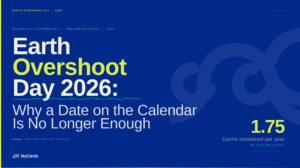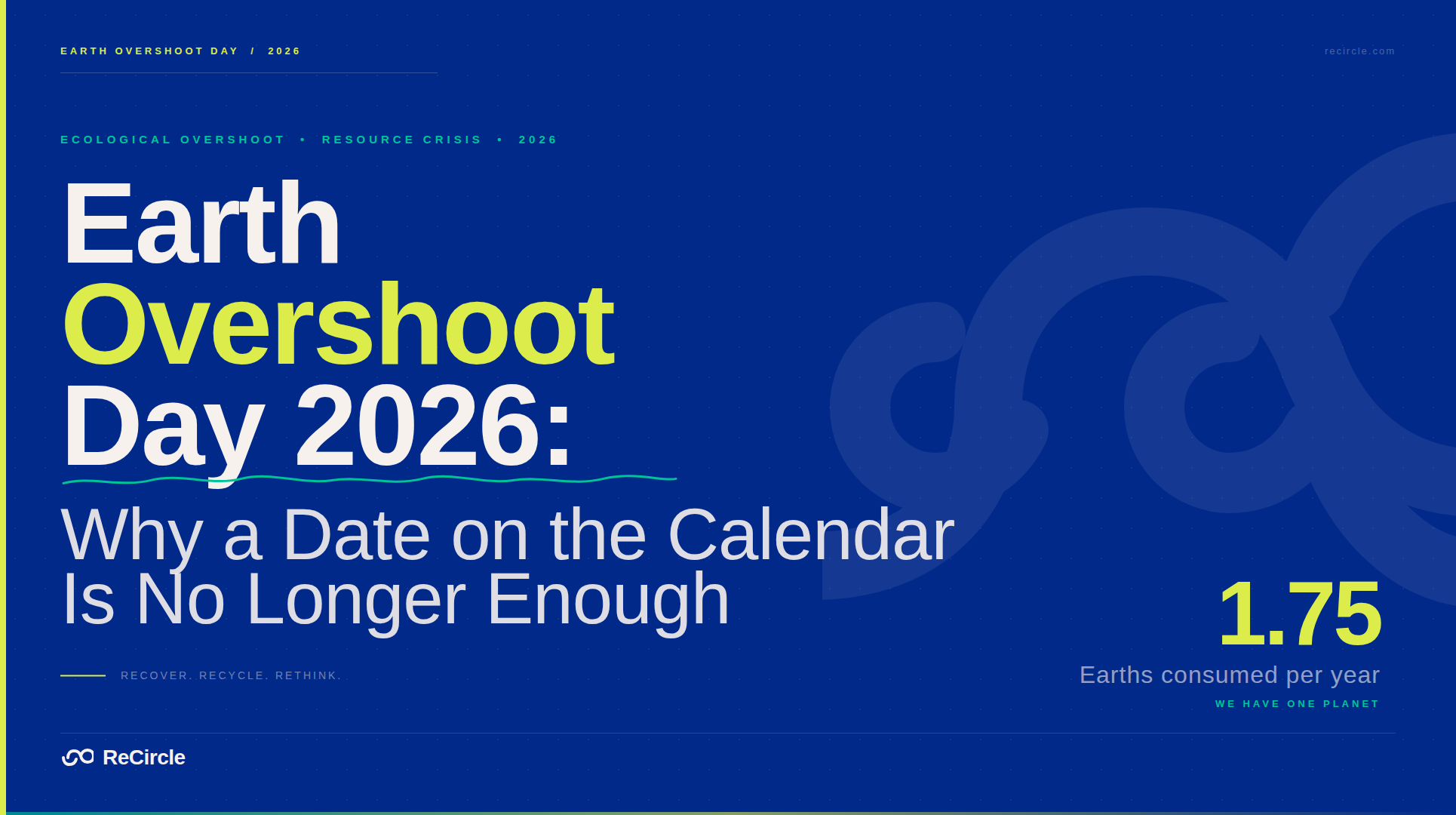
Earth Overshoot Day 2026 shows how fast we’re consuming resources. This Earth Day, it’s time to rethink how we produce, use, and waste.
Earth Day shows up every year with good intentions. We pause, reflect, maybe make a small promise to do better. It feels like a reset. But if we’re honest, that feeling doesn’t last very long.
Because not too far from Earth Day, another date quietly tells us how little has really changed. Earth Overshoot Day 2026 is expected to arrive sooner than ever. And that gap between intention and action becomes hard to ignore.
You know that feeling when your salary runs out before the month ends? You start cutting back, stretching what’s left, maybe even dipping into savings. Now imagine doing that, not for a month, but for the planet. That’s pretty much where we are.
Every year, we spend Earth’s natural resources like there’s more coming in tomorrow. And every year, that moment when we run out arrives sooner. Earth Overshoot Day 2026 is expected to follow the same pattern. Earlier again. Quieter maybe, but harder to ignore if you’re really paying attention.
What is Earth Overshoot Day 2026?
Earth Overshoot Day 2026 marks the point when humanity’s demand on nature exceeds what Earth can regenerate in that entire year. After this date, we’re no longer living within our means. We’re operating in a deficit.
The Global Footprint Network, which tracks this metric, calculates it by comparing our ecological footprint with Earth’s biocapacity. In simple terms, how much we use versus how much the planet can recover. Every year, the official Earth Overshoot Day 2026 date is announced on June 5, 2026, which is World Environment Day, but the trajectory is already set.
And this is where Earth Day becomes more than just symbolic. It sits just weeks before this announcement, almost like a checkpoint. A moment to ask whether anything is actually shifting before the numbers make it official.
To put it into perspective, back in 1972, this date fell on the last day of the year. By 2025, it had moved up to 24 July. Today, we are consuming resources at a rate that would require 1.8 Earths to sustain. But we don’t have 1.8 Earths.
Why is Earth Overshoot Day getting earlier every year?
It’s tempting to think this is just about population. It’s not. The bigger driver is how we consume.
Our systems are designed for speed and scale, not balance. We extract, produce, use, and discard, often without thinking about regeneration. This leads to resource overconsumption, where demand consistently outpaces supply, creating what experts call a global ecological deficit.
You see the effects everywhere. Forests shrink faster than they regrow. Oceans struggle to replenish fish stocks. Waste piles up because recovery systems can’t keep up. Add carbon emissions into the mix, and the pressure on planetary boundaries becomes even more intense.
This is exactly why Earth Day, on its own, isn’t enough anymore. Awareness without system-level change doesn’t slow this trend down.
So when people ask why Earth Overshoot Day is getting earlier every year, the answer is uncomfortable but clear. We are simply using more than the Earth can give back.
What happens after Earth Overshoot Day 2026?
After Earth Overshoot Day 2026, we move into ecological overshoot. That means we start depleting natural capital instead of living off its interest.
This shows up in real ways. Rising costs of raw materials. Supply chain disruptions. Increased climate risks. Biodiversity loss that affects food systems. This isn’t some distant environmental concern anymore. It’s already shaping how businesses operate and how economies behave.
And this is where the disconnect with Earth Day becomes obvious. We celebrate the planet in April, but by mid-year, we’ve already exhausted its annual budget.
Why this can’t just be another awareness date
Here’s where things get tricky. Dates like Earth Overshoot Day 2026 create awareness, but they can also create distance. It becomes something to observe rather than something to act on.
But overshoot isn’t a one-day event. It’s happening every single day through the choices we make and the systems we run.
At ReCircle, this is where the conversation shifts. Awareness is no longer the problem. Execution is. Moving towards sustainable consumption, reducing ecological footprint, and designing circular systems are not future goals. They are immediate needs.
The #MoveTheDate narrative is powerful, but it only works if it translates into consistent action. Not campaigns that spike around Earth Day, but systems that hold up throughout the year.
What needs to change now
If Earth Overshoot Day 2026 tells us anything, it’s that small, isolated actions won’t be enough.
We need to rethink how resources flow through our systems:
- Design for reuse instead of disposal
- Improve recovery so materials stay in circulation
- Reduce dependence on virgin resources
- Build models that align with a regenerative economy
These aren’t idealistic ideas. They are practical shifts that directly reduce ecological overshoot.
The gap between what we take and what Earth can give is widening
Earth Overshoot Day 2026 is not just a date waiting to be announced in June. It’s a reflection of how far we’ve drifted from balance.
And unless something changes, it will keep moving earlier.
Earth Day was never meant to be just a moment of awareness. It was meant to trigger action. But if that action doesn’t extend beyond a single day, the numbers will keep telling the same story.
The real challenge isn’t marking Earth Day or tracking Earth Overshoot Day 2026. It’s making sure our actions, every day, push that date back.
That’s where real impact lies. And that’s the space ReCircle continues to work in, not just talking about the problem but actively building solutions that close the loop and reduce resource overconsumption.
Because at the end of the day, the planet doesn’t run on calendars. But maybe we should start treating every day like it does.