India generates over 34.7 lakh tonnes of plastic waste every year. Much of it still lands in dumping grounds. We all see the packaging, but we rarely see what happens next. That invisible journey decides whether recycled plastic becomes a reliable raw material or a risky compromise.
This is the secret life of waste. The part that starts long before flakes are washed or pellets are cut.
If we want high-quality recycled plastic, we have to begin at the beginning.
Waste Is Not the Problem. The System Is.
A bottle is not bad. A wrapper is not evil. Plastic changed food safety, medicine, logistics, and even space travel. The issue is not plastic but what happens after we use it.
When waste is collected in mixed, contaminated streams, quality drops immediately. PET mixed with PVC can cause brittleness during processing. Even small traces matter. Studies in plastics technology show that minimal PVC contamination in PET can compromise performance.
That means recycled plastic does not fail at extrusion. It fails at collection.
If the collection is disciplined, the material quality stays stable. If the collection is careless, the rest of the chain struggles to fix it.
We chose to fix the chain.

Segregation Is Where Quality Is Earned
Most waste in India is still mixed at the source. Wet and dry waste sit together. Multilayer packaging sits with bottles, too. By the time it reaches a recycler, the damage is already done.
Segregation is not an operational step. It is the foundation of high-quality recycled plastic.
At our material recovery facility, Safai Saathis sort each item by material type. PET, HDPE, PP. Nothing moves forward without inspection. Optical sorting systems, such as near-infrared scanners, support this work by identifying polymers with precision. Density separation removes heavy contaminants. Metal detection protects downstream machinery.
We recover 7000 kilograms of dry waste every day. That scale demands process control. Not guesswork.
Because recycled plastic cannot be premium if its inputs are random.
Traceability Turns Waste Into Raw Material
Brands often say recycled plastic is inconsistent. One batch runs smoothly. The next behaves differently in moulding or blowing.
Inconsistency is not a material flaw. It is a traceability flaw.
If you cannot trace feedstock to its origin, you cannot manage variability. That is why we built systems like ClimaOne. Every movement of material is documented. From collection partner to processor. From processor to end product.
Regulations are tightening. EPR mandates require companies to take full responsibility for their plastic footprint. From 2025 to 2026, up to 50-60% of packaging must include recycled content. Without traceable recycled plastic, compliance becomes uncertain.
Traceability builds confidence. Confidence builds adoption.
And adoption scales impact.
Why Recycled Plastic Fails
Let us not pretend failure is rare. Recycled plastic can fail mechanical or processing tests.
Common causes are predictable. Mixed polymers create an unstable melt flow index. Residual contamination reduces tensile strength. Excess moisture creates surface defects. Poor filtration during extrusion allows impurities to pass through.
These failures rarely begin at the final stage. They start upstream.
ASTM and ISO standards measure impact resistance, elongation, and melt behaviour. When recycled plastic does not meet these benchmarks, the cause is often weak segregation or inconsistent sourcing.
Which brings us back to systems.
What Brands Should Really Be Asking
Price is important. But price without process is riskier.
If you are sourcing recycled plastic, ask about the chain of custody, not just the certificate.
Where is the feedstock sourced from? How is contamination controlled? What percentage of input is post-consumer waste? How are batches tested and documented? Can you trace the material to the collection partners?
Hindustan Unilever plans to cut virgin plastic packaging by 40% by 2028. ITC is moving towards 100% of packaging being reusable, recyclable, or biodegradable. Coca-Cola aims to collect and recycle one bottle for every bottle sold by 2030.
Your competition is already in motion.
The question is not whether recycled plastic will become standard. The question is whether your supply will be reliable when it does.

Building Infrastructure, Not Just Output
At ReCircle, we are not only producing recycled plastic. We are rebuilding India’s waste recovery chain.
We formalise Safai Saathis and provide safe working conditions, run collection drives across cities, operate recovery facilities that prioritise segregation and quality checks, and invest in recycling infrastructure designed to produce consistent PET flakes.
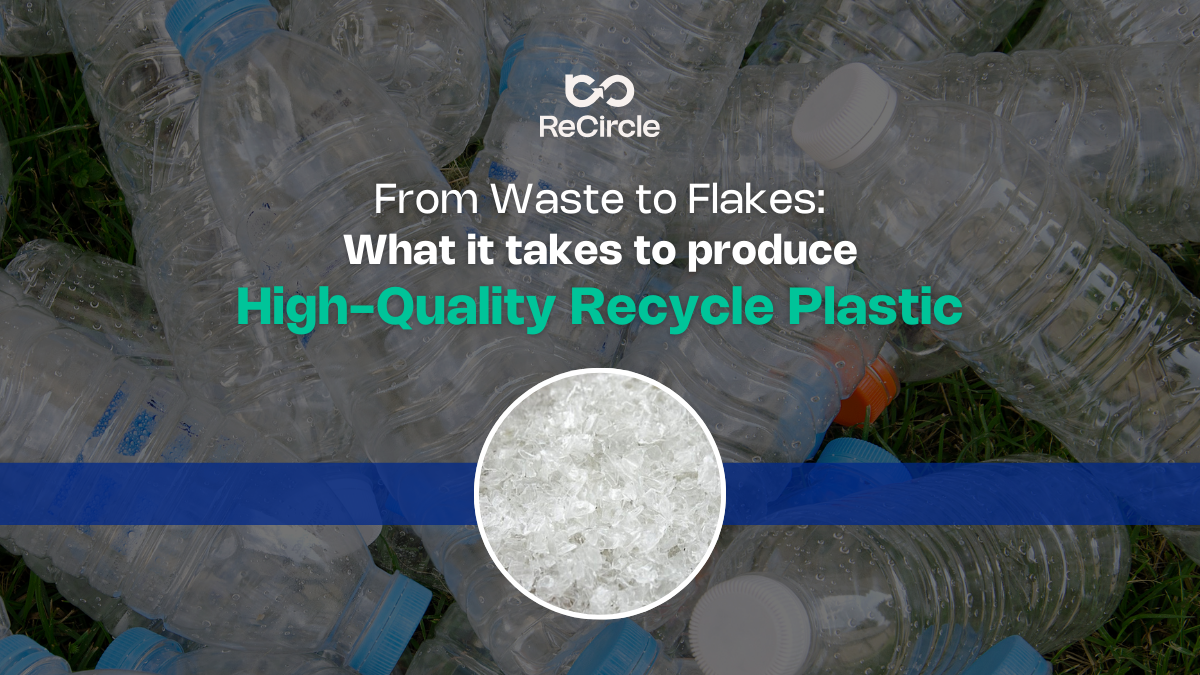
At ReCircle, we make high-quality, food-grade bottle-to-bottle flakes. They are built on controlled inputs, disciplined sorting, and full traceability, in alignment with the BIS standards. As of March 2024, we have recovered over 10,222 tonnes of dry waste. Over the last 10 years, we have diverted more than 291,217 MT of waste from landfills and oceans.
If you are looking to purchase reliable recycled plastic flakes and want a partner who understands the system behind the material, reach out to us.
Let’s build a world where waste is not the end of the story but the beginning of something better.
Frequently Asked Questions
Key benefits of proper segregation include:
- Preventing mixing of PET, HDPE, and PP polymers
- Reducing contamination from labels, metals, or multilayer plastics
- Improving consistency of recycled plastic flakes and pellets
Common technologies include:
- Near-infrared (NIR) optical scanners for polymer identification
- Density separation tanks to remove heavier contaminants
- Metal detection systems to protect machinery
- Manual quality checks for final verification
Common examples include:
- PVC mixed with PET bottles
- Food residue or organic waste
- Adhesives from labels
- Multilayer plastics or incompatible polymers
Important questions include:
- Where does the feedstock originate?
- How is contamination controlled during sorting?
- Is the material traceable to collection partners?
- How are batches tested for quality and consistency?