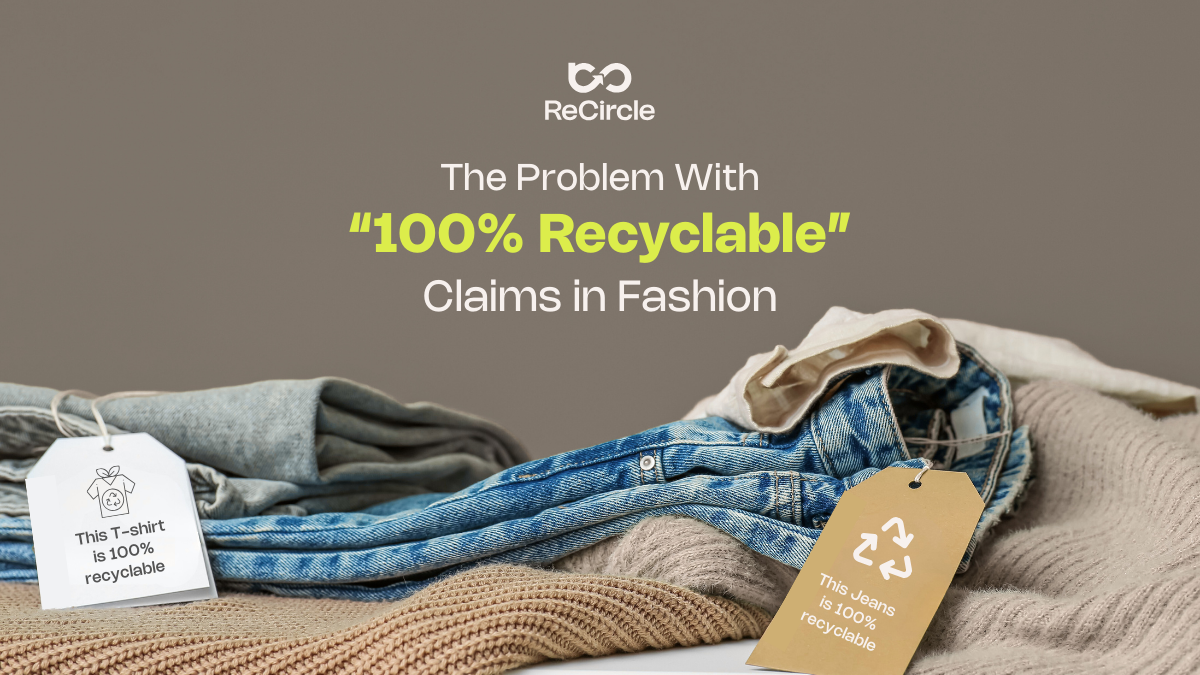
Walk into any major fashion store today, and there are chances that you’ll find a little tag on the clothes that says “100% recyclable.” Sounds responsible, right? That little tag makes you feel like buying that t-shirt is somehow part of the solution.
But here’s what brands, and you, as a consumer, need to know about textile recycling. Just because something is technically recyclable does not mean it will ever be recycled.
The growing gap between what global fashion brands claim and what actually happens to your clothes after you’re done wearing them is what this blog aims to bring to light.
Recyclable on paper. Landfilled in reality.
If a garment is 100% recyclable, how exactly does it get recycled?
Let’s say a brand designs a hoodie made from a single fibre, with no blends or mixed trims. That technically does make textile recycling easier. On paper, the garment qualifies as recyclable.
But good design alone cannot guarantee textile recycling. Efficient textile recycling requires an effective system that ensures
- Collection
- Sorting
- Transportation
- Fibre-to-fibre processing
- Workers
- Data,
- Traceability.
Without these moving parts, a recyclable product is just stranded potential.
Right now, only 15% of used textiles are recycled globally. The rest land in dumpyards and oceans, where they can take up to 200 years to decompose.
So when a global brand says “100% recyclable” but offers no structured take-back programme, what they are really saying is this: if someone, somewhere, builds the right system, this could be recycled.
That’s potential, not responsibility. And potential does not keep clothes out of landfills.
The missing piece: take-back that actually takes back.
If fashion brands are serious about textile recycling, here are a few questions their customers should be able to answer
- When I’m done with this garment, where does it go?
- Can I return it in-store?
- Is there a free doorstep pickup?
- Is it tracked?
- Do I know whether it became a new fibre or just got downcycled into rags?
Most global fashion brands cannot offer clear answers. Some stores have pilot collection bins. Others partner with third-party recyclers without disclosing actual recovery rates. Very few publish transparent data on how much textile waste they collect versus how much they produce annually.
When “100% recyclable” becomes greenwashing
Greenwashing happens when brands exaggerate or mislead consumers about their environmental efforts. The phrase “100% recyclable” sits dangerously close to that line when there is no clear pathway for consumers to return the product.
Regulators across the world are tightening rules around green claims. Extended Producer Responsibility frameworks are expanding. Environmental scrutiny is no longer optional.
When a brand publicly claims that its garments are 100% recyclable, it implicitly suggests that textile recycling pathways are available and effective. If that cannot be demonstrated with data, the claim becomes vulnerable.
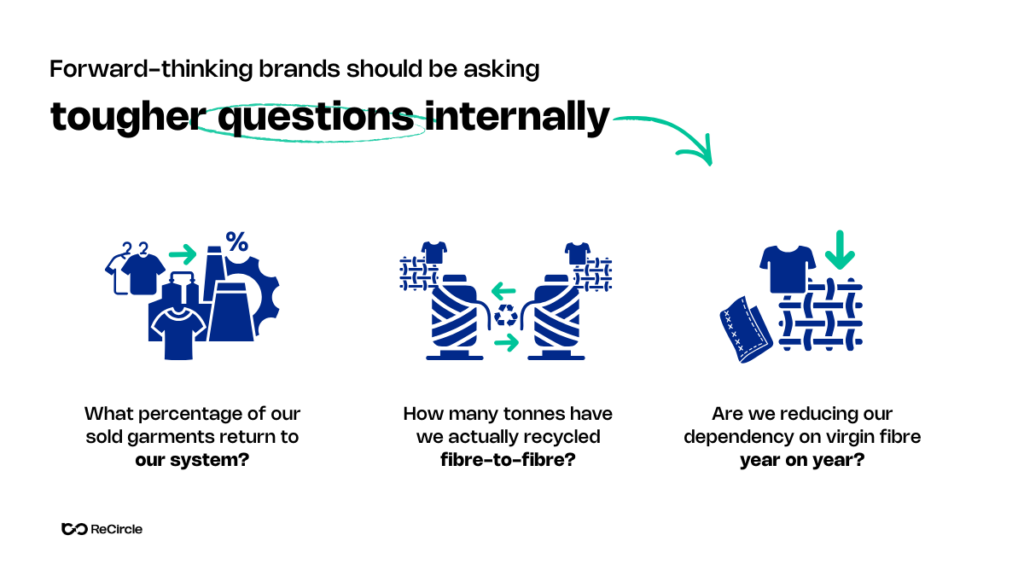
Forward-thinking brands should be asking tougher questions internally:
- What percentage of our sold garments return to our system?
- How many tonnes have we actually recycled fibre-to-fibre?
- Are we reducing our dependency on virgin fibre year on year?
If those numbers are unclear, the recyclable label is premature.
What real textile recycling leadership looks like
Let’s imagine a different approach. You buy a jacket. Inside is a QR code. It shows you the material composition, carbon footprint, and most importantly, the return pathway. When the jacket reaches the end of its life, you schedule a pickup. The garment is processed at a certified textile recycling facility. You receive confirmation once it re-enters the supply chain as recycled fibre.
That is accountability.
Textile recycling on the ground includes:
- A compulsory global take-back programme across all markets
- Transparent annual reporting on collection and recycling rates
- Investment in textile recycling plants, not just design innovation
- Publicly verifiable traceability systems
- Measurable reduction in the production of virgin materials
Anything less is partial progress. And partial progress cannot solve a crisis of this scale.
This is bigger than a tag
The fashion industry loves to celebrate innovation. Innovation in new fibres, bio-based fabrics, recycled blends & limited-edition “circular” drops.
But we cannot innovate our way out of waste if we refuse to collect it.
Textile recycling does not begin at the design table. It begins at the end of life, and right now, that’s where most brands go quiet.
The world already generates 92 million tonnes of textile waste each year. That number is projected to rise to 134 million tonnes by 2030.
So this conversation is no longer about better labels but about how we can build better systems.
And that’s where the real shift needs to happen.
Bridging the gap between “recyclable” and recycled
Whether you’re a fashion brand or a consumer and have read this far, you might have one very obvious but genuine question: if brands genuinely want to close the loop, where do they even start, or how do they do it without turning it into another pilot project? They start by either building the infrastructure themselves. Or they partner with someone who already has it.
And this is where ReCircle comes in. If your brand wants to move beyond recyclable claims and into real textile recycling, we design structured take-back programmes tailored to your scale. Whether you operate in five cities or fifty, online or offline, we create a system that brings your garments back into circulation instead of leaving them to chance.
Here’s what that actually means for you:
- End-to-end collection systems that are easy for your customers to use
- Verified sorting and processing through trusted recovery partners
- Clear segregation of what gets recycled, upcycled, repurposed, or responsibly processed
- Detailed impact reporting that tells you exactly how many tonnes were collected and where they went
This kind of data is powerful for your business. It strengthens your ESG disclosures, builds investor confidence, gives your marketing team something honest to communicate with, and allows your customers to see that when you say ‘textile recycling’, you actually mean it.
If you’re a global fashion brand still relying on “100% recyclable” as your sustainability headline, this is your moment to go deeper.
Let’s build a take-back programme that closes the loop on your garments and gives you the transparency your customers are already demanding.
Reach out to us to build your customised takeback programme.