Walk into any sustainability review at a major FMCG or packaging company in India right now, and you will find the same two conversations happening in the same room but not with each other.
The sustainability team is managing EPR credits, filing CPCB documentation, and hitting annual targets. The procurement team is scrambling to source certified rPET for recycled content commitments that are now due, not pending. Both are under pressure. Neither is solving the other’s problem.
That gap is the most expensive mistake brands are making in 2026.
Extended producer responsibility plastic has been treated as a regulatory checkbox for years. Register. File. Transfer credits. Repeat. That made sense when EPR enforcement was light and recycled content mandates were still on the horizon. Neither condition holds today.
Recycled content targets for rigid packaging are active and rising. CPCB documentation requirements have tightened. And the supply of certified, traceable rPET, the material that actually satisfies brand packaging specifications is constrained in a way that will not self-correct.
Here is the part that changes the conversation: the brands best positioned in this market did not build a separate PCR supply strategy. They built a serious EPR for plastic packaging program with real infrastructure, real collection, real recycling and found that genuine compliance produces verified rPET as a direct byproduct.
That byproduct is now competitively valuable. And the brands that bought cheap credits instead of building real compliance have no share of it.
1. The rPET Supply Gap Is Structural, Not Temporary
Demand for certified rPET has pulled ahead of verified supply. Three forces are driving it simultaneously:
- Mandatory recycled content targets under India’s Plastic Waste Management Rules
- Voluntary sustainability commitments made in 2021–2023 with 2025–2027 delivery windows now open
- ESG scrutiny from investors who distinguish traceable rPET from unverified recycled content claims
India emits approximately 9.3 million tonnes of plastic into the environment annually — the highest of any country in the world, accounting for nearly one-fifth of global plastic pollution emissions. Of this, 3.5 million tonnes escape as unburned debris, lost to land and waterways before they can enter any certified rPET supply chain, according to a September 2024 study published in Nature by researchers at the University of Leeds.
The result: procurement teams that went to the open market for certified rPET in late 2025 found prices up, lead times extended, and certification documentation the kind that satisfies a brand’s own packaging standards difficult to obtain through spot purchases.
This is not a supply blip. There is a structural gap between how fast demand for certified rPET is growing and how slowly verified processing infrastructure is being built. That gap widens unless brands actively fund the collection and recycling systems that close it which is precisely what well-executed EPR for plastic packaging does.
2. What Genuine EPR for Plastic Packaging Actually Produces
Every tonne of extended producer responsibility plastic compliance that is genuinely executed through real collection, real sorting, real certified recycling produces two outputs simultaneously:
- A compliance credit on the CPCB portal
- Certified recycled material re-entering the supply chain as rPET flakes, granules, or fibre
When brands fund this year over year through a partner with real physical infrastructure, they are not just satisfying an obligation. They are building a supply chain. Collection networks grow. Processing capacity scales. Certified rPET output increases.
Over three to four years, the brand has a relationship with a recycling ecosystem producing exactly the feedstock their packaging team needs verified, certified, traceable from source to output.
That is the asset class argument. EPR spend directed into real infrastructure is an investment in future supply security. The return is not financial in the conventional sense. It is strategic access to certified rPET at a time when access is the constraint.
3. Paper Compliance vs. Infrastructure Compliance
Not all EPR for plastic packaging is the same. This distinction now has direct commercial consequences.
| Particulars | Paper-Based EPR | Infrastructure-Backed EPR |
| Credits on CPCB portal | ✓ | ✓ |
| Chain of custody documentation | ✗ | ✓ |
| Certified rPET generated | ✗ | ✓ |
| Audit-defensible records | ✗ | ✓ |
| Supply chain built | ✗ | ✓ |
Paper compliance meets the portal minimum. It produces no rPET, no traceable chain of custody, and no supply relationship. Infrastructure compliance does both: it satisfies the regulator and generates the feedstock.
CPCB enforcement has tightened to reflect this. Audits now require granular documentation at each stage collection, weight records, processor certifications, recycling output data. Compliance built only on purchased credits is increasingly exposed under that level of scrutiny.
Brands that built traceable extended producer responsibility plastic programs in 2023–2024 now have certified rPET supply relationships in place. Brands that bought the cheapest credits are now paying spot market premiums for material they should have been building access to.
4. The Certification Layer That Narrows the Supply Pool
Not all rPET is equivalent for brand specifications. The certification tier determines which supply pool you are drawing from and they are not the same size.
Ocean Bound Plastic (OBP) Certified rPET
Recovered from within 50 km of coastlines in regions without formal waste management. Without intervention, this plastic enters waterways. OBP-certified rPET commands a market premium, is independently audited, and is increasingly specified by name in global brand packaging requirements. Supply is genuinely limited.
GRS (Global Recycled Standard) Certified rPET
Verifies recycled content and tracks it through the supply chain with a documented audit trail. For brands making on-pack recycled content claims, GRS certification on rPET feedstock is moving from differentiator to minimum requirement. Without it, recycled content claims face growing regulatory and retailer scrutiny.
Brands specifying certified rPET are operating in a meaningfully narrower supply pool than brands accepting uncertified material. An EPR for plastic packaging partner that generates OBP or GRS certified output addresses that constraint directly. An EPR partner generating only portal credits addresses none of it.
5. Why 2026 Is the Pressure Point
Three forces converged at the same time. That is why this year feels different from 2024.
Regulatory
- Mandatory recycled content for rigid packaging is at 30% for FY 2025–26 under India’s PWM Rules, rising to 60% by FY 2028–29
- Flexible packaging EPR recycled content targets start at 10% from FY 2025–26
- CPCB documentation requirements have risen gap filings that passed two years ago are now flagged for additional verification
Market
- Certified rPET is trading above virgin resin prices in categories where it historically traded at parity a structural reversal driven by mandate-led demand
- Brands with offtake agreements tied to their EPR for plastic packaging programs are insulated from spot volatility
- Brands entering the open market now are price-takers, not price-setters
ESG and Financing
- Sustainability-linked loan covenants and investor ESG frameworks increasingly require verified rPET sourcing documentation, not just EPR credit certificates
- The audit question has shifted: not whether extended producer responsibility plastic credits exist, but whether verifiable material recovery sits behind them
6. What the Right EPR Strategy Looks Like in Practice
EPR for plastic packaging compliance and PCR supply are not separate workstreams. They are the same workstream at different time horizons. Here is how teams getting this right are approaching it:
Pick partners on traceability, not cost per tonne
Ask for collection data, processor certifications, and rPET output documentation before signing. An EPR partner who cannot show you this is not building a supply chain; they are processing paperwork. The cost saving is real in year one. The supply exposure is larger in years two and three.
Align EPR geography with your distribution footprint
Your extended producer responsibility plastic program should be recovering material in the same regions your products are sold. Geographically disconnected recovery patterns are an audit risk and produce no usable supply intelligence for your procurement team.
Connect EPR data to procurement planning
Certified rPET output data from your EPR for plastic packaging program is live market intelligence. It tells procurement what verified material is available, through which certified channels, at what quality. This data belongs in procurement dashboards not only in sustainability reports that procurement never sees.
Consider voluntary programs as supply strategy
The Plastic Neutral Program extends beyond mandatory EPR obligations. The certified rPET relationships built through voluntary activity become a practical feedstock buffer as mandatory recycled content targets rise. Brands running voluntary programs in 2024–2025 are building the supply reserve their competitors will need in 2027.
Conclusion
The brands best positioned in the 2026 certified rPET market did not get there by spending more on extended producer responsibility plastic compliance.
They got there by spending with intention treating EPR for plastic packaging as infrastructure investment, not a regulatory cost. The logic holds in both directions:
- Verified EPR compliance funds real collection
- Real collection generates certified rPET
- Certified rPET satisfies recycled content mandates, ESG commitments, and investor requirements simultaneously
For teams still managing EPR as a filing exercise, the market is making the case. The question is no longer whether to build real EPR for plastic packaging infrastructure. It is how quickly it can be done before the certified rPET supply window narrows further.
2026 is not the year to optimise compliance spending. It is the year to build supply security.
How We Approach This at ReCircle
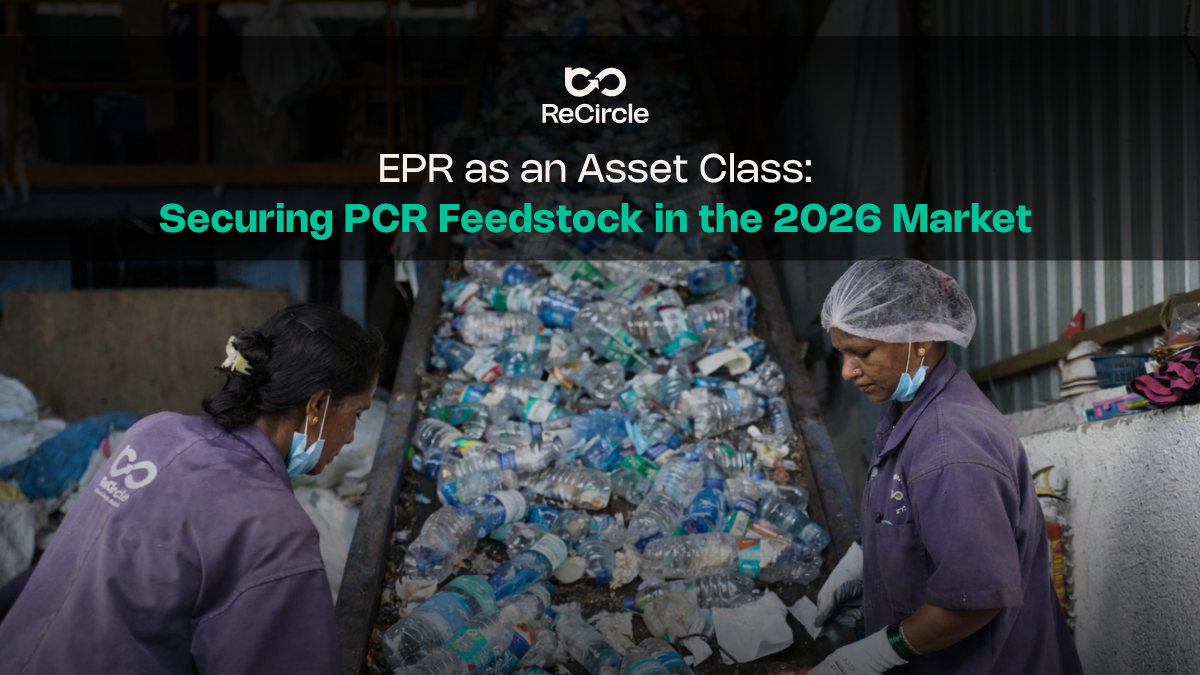
We have spent nine years building the infrastructure that makes extended producer responsibility plastic compliance physically real across India, spanning 271+ cities, 400+ collection partners, 3,100+ Safai Saathis, and a network of material recovery and recycling facilities, including a recycling plant in Bhiwani that produces rPET flakes.
Our ClimaOne platform generates a complete, auditable chain of custody from collection through certified rPET output so every credit our clients receive on the CPCB portal is backed by verifiable material recovery documentation.
We work across all plastic categories, including hard-to-recycle multilayer and flexible packaging that most EPR for plastic packaging programs route around. And the rPET we produce is designed to meet the specifications that matter to brand packaging teams, not just minimum compliance requirements.
If your team is building an EPR strategy for FY 2025–26 or a certified rPET sourcing plan for the next procurement cycle, we are ready to show you exactly how our supply chain works.
Frequently Asked Questions
Q1. What is the difference between EPR credits and actual rPET supply?
EPR credits are compliance instruments on the CPCB portal. rPET is the physical recycled material generated by that process. Infrastructure-backed extended producer responsibility plastic compliance produces both. Paper-based compliance produces only the credit, no material, no supply chain, no chain of custody.
Q2. Why is certified rPET supply tightening in India?
Formal certified collection captures only a fraction of India’s 9.3 million tonnes of annual plastic waste generation. The gap between demand for traceable rPET from active mandates and brand pledges and what verified EPR for plastic packaging programs are actually producing is the constraint. It will widen before it narrows.
Q3. How does OBP differ from GRS certification for rPET?
GRS verifies recycled content and tracks it through the supply chain. OBP certifies the material was recovered from a coastal at-risk zone. Both may be required depending on your packaging specification they are not interchangeable.
Q4. How do we verify our EPR partner is generating real rPET?
Ask for collection weight records, processor facility certifications, and certified rPET output documentation. If your EPR for plastic packaging partner cannot produce a traceable chain of custody from collection point to certified output, no supply chain is being built behind your credits.
Q5. Can our EPR compliance directly feed our packaging line with rPET?
Not automatically. You need an offtake agreement giving you preferential access to the certified rPET your program generates. This is only viable when your EPR partner operates its own processing infrastructure, not when they solely aggregate credits from third parties.
Q6. What is the Plastic Neutral Program and how does it relate to EPR?
It extends beyond mandatory extended producer responsibility plastic obligations, allowing brands to offset their full plastic footprint. The certified rPET supply relationships built through voluntary activity serve as a practical feedstock buffer as mandatory recycled content targets rise making it a supply strategy as much as a communications one.
Q7. When should we start building an EPR program that also secures rPET supply?
Before FY 2025–26 targets are locked. Brands with the strongest certified rPET positions built their EPR for plastic packaging infrastructure relationships in 2023–2024. The lead time from program launch to meaningful certified rPET output is 18–24 months minimum. Starting now still puts you ahead but there is no benefit to waiting further.