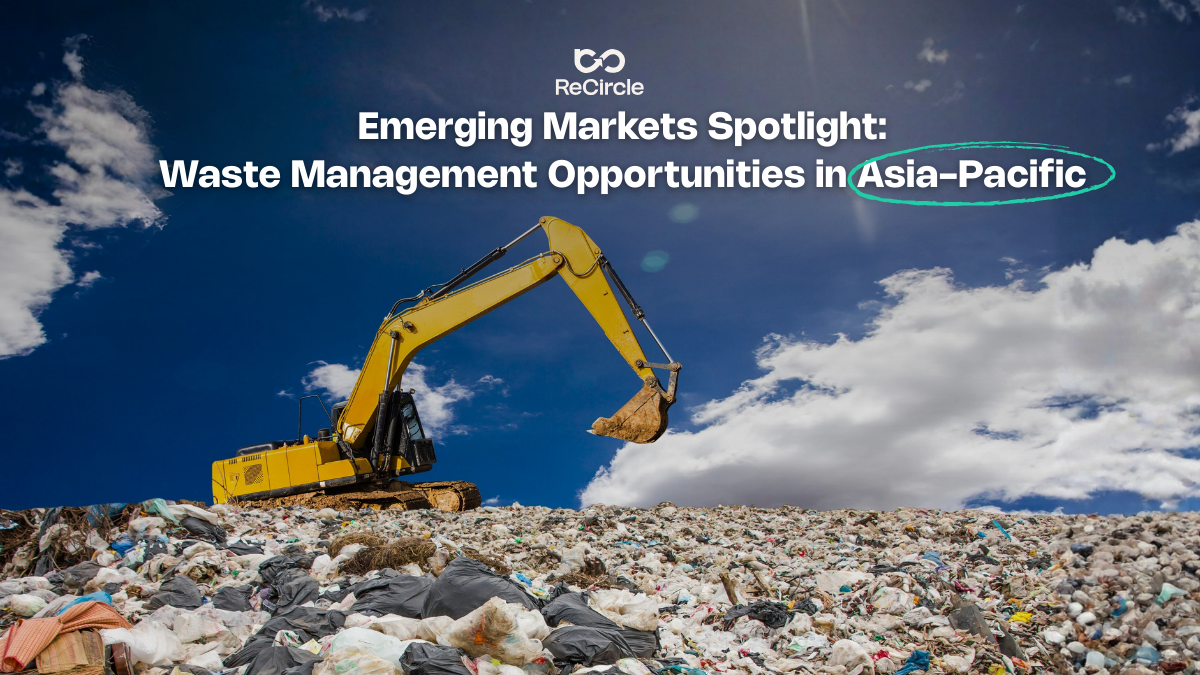
When people talk about waste management in Asia-Pacific, the discussion usually begins from the same point. Too much waste, not enough infrastructure, cities growing faster than systems can handle. All of this is true in many ways, but it is also not the complete picture.
The other side of the story is that this region now represents one of the biggest opportunity areas in global waste management. Regulations are getting stricter, companies are being held more responsible for what happens to their waste, and investors are starting to look at circular economy performance more seriously. Because of that, waste is no longer only about disposal anymore; it is turning into a structured and investable sector, although it is still not even everywhere.
What makes Asia-Pacific interesting is that opportunities are concentrated in certain sectors where three conditions overlap: high waste generation, increasing regulation, and weak or limited formal infrastructure. Where these things meet, activity is growing faster.
Textiles, manufacturing, electronics, construction and organic waste are currently leading this shift. Each one is moving at different speed and in different countries, but overall direction is toward more formal systems and higher expectations than before.
The regional waste management market was valued roughly at USD 770 billion in 2025 and could reach about USD 1.47 trillion by 2035. This growth will not happen uniformly or smoothly. It will likely cluster in areas where pressure and demand are strongest.
Below are the sectors where opportunities appear most noticeable right now.
1. Textile Waste — Very Large Volumes, Weak Systems
Textile waste is one of the least organised waste streams despite its huge size. Globally, the industry produces about 92 million tonnes of waste annually, and Asia-Pacific contributes a major share since it manufactures for global markets while also accounting for substantial domestic consumption.
However, most textile waste still does not pass through formal recovery channels.
Factory waste (pre-consumer) often ends up in landfill or low-value uses. Post-consumer clothing collection is fragmented and frequently handled by informal networks with little traceability. Meanwhile, global brands increasingly demand verified recycling and documented diversion, creating a mismatch.
Why the gap exists
- Limited structured recovery channels for manufacturing waste
- Inconsistent clothing collection systems across regions
- Advanced recycling tech not yet deployed widely
- Documentation expectations higher than informal systems can provide
Where opportunity sits
- Building reliable used-clothing collection networks
- Recovering factory waste directly at source
- Producing certified secondary fibers
- Providing traceable compliance reporting
- Formalizing the Waghri community and leveraging their decades-long expertise in textile waste collection and sorting
In many ways, demand for formal textile solutions is growing faster than supply right now.
2. Manufacturing & Industrial Waste — Continuous and Regulation-Driven
Manufacturing is a central pillar of Asia-Pacific economies and produces large, continuous waste streams across sectors like electronics, automotive, chemicals and pharmaceuticals.
Industrial waste management in the region may approach USD 46 billion by 2030. This growth will largely be fueled by manufacturers transitioning from informal disposal to compliant waste management systems, driven by tightening environmental regulations, more consistent enforcement, extended producer responsibility mandates, corporate ESG obligations, buyer-led compliance requirements across global supply chains, and escalating legal, financial, and reputational consequences of non-compliance.
Manufacturers today are not only looking for removal services. They want partners who can demonstrate responsible handling, recovery outcomes and regulatory compliance.
Key opportunity areas
Electronics & Semiconductor Production
- Generates metal-rich waste with recovery value
- Increasing regulatory oversight
- Certified recycling becoming mandatory in some cases
Automotive Manufacturing
- Produces metals, plastics, rubber and hazardous waste
- Global companies pursuing zero-waste targets
- Demand for traceable recycling solutions rising
Chemical & Pharmaceutical Industries
- Produce regulated hazardous waste streams
- Compliance risks require certified operators
What manufacturers expect now
- Documentation for audits
- Verified recycling outcomes
- Traceable chain of custody
- Alignment with regulations
Providers delivering these capabilities often become long-term partners instead of short-term vendors.
3. E-Waste — High Value but Uneven Systems
Electronic waste is economically attractive because discarded devices contain valuable recoverable metals. Asia-Pacific generates the largest share of global e-waste and is also a major electronics manufacturing hub.
Why the sector is accelerating
- Rapid device consumption growth
- Producer responsibility laws in multiple countries
- Enforced recovery targets
Remaining gaps
- Informal collection dominates in many regions
- Weak documentation and traceability
- Uneven distribution of advanced recovery facilities
- Unsafe processing still present in some places
What formal systems can deliver
- Certified collection and transport
- Safe processing infrastructure
- Verified recovery rates
- Compliance-ready documentation
- Traceable recycled outputs
Because of both material value and regulatory pressure, e-waste will likely remain a major growth segment for years.
4. Construction & Demolition Waste — Tied to Urban Growth
Rapid urbanisation is generating massive construction and demolition waste volumes, already the largest industrial waste category by weight. Recycling capacity has not kept pace with construction activity.
Drivers pushing formalisation
- Mandatory waste rules for large projects
- Green building certifications
- ESG reporting requirements
Current limitations
- Insufficient specialised processing facilities
- Weak markets for recycled construction materials
- Limited tracking of waste from sites
Emerging opportunities
- Building sorting and recovery plants
- Producing certified recycled aggregates
- Providing compliance support to developers
As infrastructure spending continues, structured management of this waste stream becomes more critical.
5. Food & Organic Waste — Early but Promising
Organic waste forms a large portion of total waste generation, yet formal systems remain underdeveloped compared to other sectors.
Regulation is less mature here, but interest is increasing due to energy recovery potential and sustainability goals.
Drivers of demand
- Waste-to-energy initiatives
- Corporate food waste reduction targets
- Demand for organic fertilisers
Why this sector differs
- Infrastructure is still developing
- Lower competitive intensity
- Multiple revenue streams possible (energy, compost, etc.)
Returns may take longer to realise, but long-term potential is substantial.
What These Sectors Share
Despite differences, several trends appear across all sectors.
Regulation shaping the market
Policies such as producer responsibility and recycling mandates are turning waste management into a compliance requirement rather than optional activity.
Documentation becoming critical
Stakeholders increasingly need verifiable proof of handling, not just assurances.
Gradual formalisation
Informal systems still manage large volumes, but structured models are expanding.
Conclusion
Waste management opportunities in Asia-Pacific are better understood by sector rather than geography. Each waste stream has distinct economics, regulations and infrastructure needs.
Growth toward a USD 1.47 trillion market by 2035 will concentrate where formal systems are most urgently required and regulatory pressure is highest.
Organisations investing now are effectively building foundations for future circular economies, although outcomes will vary by country and sector.
How We See This at ReCircle
At ReCircle, we operate within this changing landscape daily.
Over the last decade, our focus has been on building systems that make waste management measurable, compliant and scalable. The approach connects collection, processing and reporting so outcomes can be verified across the value chain.
Focus areas include
- Formal collection networks across multiple geographies
- Certified recycling and recovery pathways
- Digital traceability via the ClimaOne platform
- EPR compliance support with audit-ready reporting
- Corporate and public-sector partnerships
- Integration of informal sector participants into formal systems
Our operations currently span plastics from manufacturing and packaging streams, as well as textiles through dedicated recovery infrastructure.
For organisations dealing with waste obligations in Asia-Pacific, the challenge is not only managing waste but proving responsible handling. The goal is to provide systems that make this possible at scale, though implementation complexity varies widely across regions.
Frequently Asked Questions
Q1. Why focus on sectors rather than countries for waste management opportunities in Asia-Pacific?
Because the commercial opportunity is defined by what is being generated and what regulation is mandating, not by geography alone. Textile waste, e-waste, and construction waste each have distinct recovery economics, EPR frameworks, and infrastructure gaps that exist across multiple markets simultaneously. Sector analysis tells you which waste streams have the strongest commercial case and the clearest regulatory tailwind, which is more useful than a country map.
Q2. Which sector has the highest growth rate in Asia-Pacific waste management?
E-waste management is growing at the fastest rate globally at a CAGR of 14.2% through 2034, with Asia-Pacific holding over 48% of global market share. The combination of high-value recoverable materials, active EPR enforcement, and large electronics production and consumption volumes makes it the most commercially dynamic sector in the region.
Q3. What makes textile waste management a particularly significant opportunity right now?
The Asia-Pacific textile waste management market is growing at 8.47% CAGR through 2034 — the fastest of any sector in the region. The infrastructure gap between what is being generated and what existing systems can formally handle is among the largest of any waste stream. Post-consumer collection, brand documentation requirements, and the shift toward certified fibre recovery are all pulling demand ahead of the current supply of compliant operators.
Q4. How does EPR change the waste management opportunity in these sectors?
EPR converts waste management from a discretionary activity into a mandatory compliance obligation with financial consequences for non-compliance. That creates formal, regulated demand for collection, processing, certification, and documentation services. It also raises the bar significantly for operators — informal and undocumented waste handling can no longer satisfy what regulators and brands require.
Q5. Why is food and organic waste considered earliest-stage despite its large volumes?
The regulatory frameworks around organic waste management are less mature and enforcement is lighter compared to electronics, textiles, and construction. The formal infrastructure for anaerobic digestion, certified composting, and biogas recovery is early-stage across most Asia-Pacific markets. That makes it less immediately commercial than other sectors but potentially the largest long-term opportunity for operators building ahead of the mandate.
Q6. What does formalisation actually mean in the context of these waste management sectors?Formalisation means converting what is currently informal, undocumented, and unverified waste management activity into compliant, traceable, certified systems. It means collection that can be tracked, processing that can be audited, and output that can be certified for recycled content claims or EPR credit generation. The gap between what the informal sector currently provides and what brands, regulators, and investors now require is where the commercial opportunity in every one of these sectors sits.