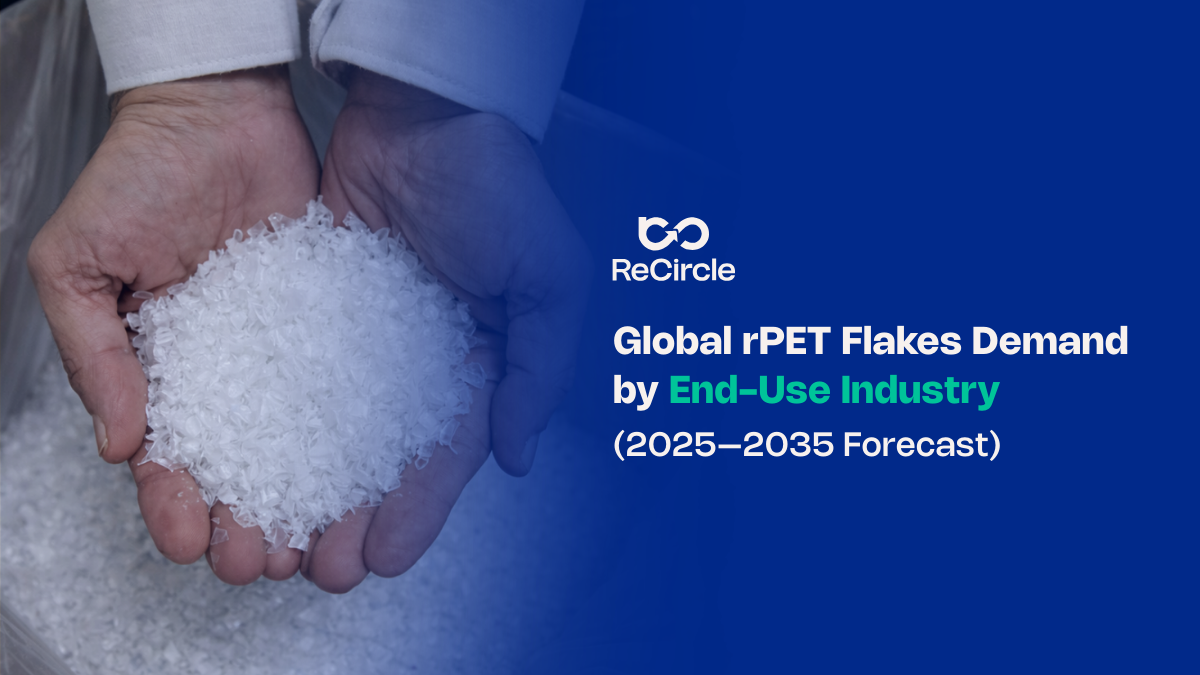
A decade ago, the market for post-consumer recycled PET was essentially one story: collect bottles, wash and shred them, sell the material back to beverage companies.
That loop still runs. But it now feeds a market that looks almost nothing like it did in 2015.
Today, six distinct industries compete for the same certified recycled feedstock. Packaging brands are racing hard regulatory deadlines. Sportswear companies have made recycled polyester a baseline, not a feature. Automakers are building recycled content into vehicle interiors because European directives now require it. Construction and geotextile applications are quietly absorbing everything that does not qualify for the premium segments above.
What ties all of them together is one material. And if your organisation makes sourcing, procurement, or sustainability decisions anywhere in this space, understanding where that demand is heading by industry is practical intelligence, not background reading.
Here is the full picture.
The Market in Numbers
The global rPET flakes market was valued at USD 11.17 billion in 2024. By 2035, that figure is projected to reach USD 38.23 billion, at a CAGR of 11.83%.
That is more than triple in a single decade. And what makes this particular growth story different from most materials markets is that demand is not concentrating in one or two segments. It is broadening simultaneously across industries with completely different regulatory drivers, specification requirements, and procurement timelines.
The supply, however, is not growing at the same rate. Certified, verifiable post-consumer material remains constrained relative to what these industries collectively need. That asymmetry is what makes the end-use breakdown genuinely worth understanding.
(Source: Spherical Insights, Recycled PET Flakes Market 2035)
1. Packaging — Biggest Pressure, Hardest Deadlines
Packaging is where the mandate pressure is most immediate, and where the consequences of not having certified supply in place are most visible.
The regulatory stack is active from multiple directions:
- The EU’s Single-Use Plastics Directive requires beverage bottles to contain at least 25% recycled content from 2025, rising to 30% by 2030 (Source: European Commission, SUPD)
- India’s Plastic Waste Management Rules set 30% recycled content for rigid packaging in FY 2025–26, rising to 60% by FY 2028–29
- Major FMCG brands carry voluntary commitments layered on top of those minimums and those commitments are now in their delivery windows
Within this segment, grade matters more than volume. Food-contact applications require rPET flakes processed through EFSA or FDA-approved decontamination systems. This is a more demanding production process than standard recycling, requiring cleaner source material, tighter sorting, and more rigorous validation. Food-grade output is harder to produce, costs more, and is genuinely in shorter supply than non-food alternatives.
Brands with long-term offtake relationships built through their EPR programs are insulated from this. Brands relying on spot purchases are not.
2. Textiles and Fibre — Where the Volume Lives
The textiles segment does not generate the highest price per tonne. But it absorbs the highest volume of any end-use category in the market.
Post-consumer PET is converted into polyester staple fibre and filament yarn, which goes into clothing, sportswear, upholstery, carpets, and non-woven industrial fabrics. The drivers here are a combination of brand commitments and steady industrial demand:
- Adidas reported that 96% of all polyester used across its products came from recycled sources by end of 2024
- Nike, Patagonia, and H&M have made similar public commitments that are pulling certified recycled polyester out of the market at scale
- Non-woven applications in healthcare, geotextiles, and filtration absorb lower-grade material that does not qualify for the apparel segments above
The textile segment is also the primary commercial route for coloured post-consumer PET, which cannot enter food-contact applications. For producers and collectors, textiles provide the baseline volume absorption that makes the economics of full-spectrum sorting viable. Without it, a significant portion of collected material has no viable market.
3. Non-Food Bottles and Containers — Fastest Growing, Most Competitive Right Now
This segment is projected to grow at a CAGR of 11.89% from 2025 to 2033, which puts it among the highest growth rates across all end-use categories.
It covers personal care, household cleaning products, detergents, cosmetics, and pharmaceutical containers. These brands face significant ESG pressure but do not require the food-contact decontamination standard, which makes certified recycled content more accessible and cost-competitive than it is for beverage packaging.
Three specific forces are driving this segment:
- Personal care and household brands with public recycled content commitments that are now in active delivery windows
- Retailers embedding recycled content requirements into supplier specifications, passing the mandate downstream through the supply chain
- Coloured PET gaining traction in milk packaging and cosmetics, where sustainability credentials and product differentiation align
It is worth noting that this is also the segment where the most procurement teams are entering the certified recycled plastics market for the first time in 2025 and 2026. That makes it one of the most competitive segments for available feedstock right now.
(Source: Grand View Research, rPET Flakes Market Report 2033)
4. Automotive — Long-Cycle, But Structurally Growing
Automotive is the segment most procurement teams underestimate when they think about where recycled PET demand is heading.
Post-consumer polyester fibre is used in car seat covers, boot linings, acoustic insulation panels, carpet underlay, and door panel lining. This is not a niche application. It is a growing one, pushed by binding European regulation.
The EU’s End-of-Life Vehicle Regulation, agreed in December 2025, mandates that new vehicles contain a minimum of 15% recycled plastic within six years of the regulation coming into force, rising to 25% within ten years. That creates a structural, legislated demand floor for recycled polymer content in vehicle manufacturing.
What makes automotive distinct as a demand segment is the procurement cycle. Automotive OEMs work on multi-year supplier agreements, typically three to five years. Once a recycled material is specified into a component, the volume commitment is effectively locked. That gives automotive buyers a stability profile that few other end-use segments can match, and makes them attractive long-term offtake partners for producers with consistent output.
The constraint is consistency. Automotive applications require uniform material properties across batches. Supply of consistent-grade certified recycled PET suitable for interior applications remains limited relative to the demand that regulation is now creating.
5. Construction — The Segment That Quietly Holds Everything Together
Construction is currently the smallest named end-use segment for certified recycled PET. It is also one of the most important to the overall market economics.
The applications here are geotextiles, insulation batts, drainage membranes, and reinforcement fibre for composite construction materials. Volume is being driven by:
- Green building certification programmes including LEED, BREEAM, and India’s GRIHA, which award credits for recycled content in materials
- Infrastructure investment across Asia Pacific and the Middle East, where geotextile demand is significant
- Growing adoption of recycled polyester insulation in low-carbon building design
Construction absorbs mixed-colour and lower-specification post-consumer PET that does not qualify for food-grade packaging or high-clarity apparel applications. That secondary market absorption is what allows producers to sort and process full-spectrum material economically. Remove it, and the economics of collection at scale become harder to justify.
6. Regional Demand — Where Growth Is Landing
Asia Pacific
Asia Pacific held the largest revenue share at 30.37% in 2024 and remains the dominant producing and consuming region. China and India lead on both sides of that equation. India’s domestic demand for certified recycled PET is accelerating as EPR-linked recycled content mandates activate across packaging categories. The region leads on collection volume but still lags on certified, food-grade output relative to what domestic and export demand is asking for.
(Source: Grand View Research, rPET Flakes Market Report 2033)
Europe
Europe is the most regulation-dense market in the world for recycled plastic content. Demand for certified food-grade material is running ahead of domestic production, making Europe an active import market. OBP and GRS-certified production from India is specifically positioned to serve this gap, given the certification standards European buyers require.
(Source: European Commission, Packaging and Packaging Waste Regulation)
GCC Countries
The GCC sub-region is projected to grow at a CAGR of 12.21% from 2025 to 2033, the highest rate of any sub-region globally. Vision 2030 sustainability programmes across Saudi Arabia and the UAE are pulling import demand for certified recycled materials from global brands operating in the region. For Indian producers, the GCC is one of the most accessible and fastest-emerging export markets available.
(Source: Grand View Research, rPET Flakes Market Report 2033)
What This Means for Sourcing Teams
Here is a clean read of where each segment sits heading into the forecast decade:
| Segment | Primary Growth Driver | Feedstock Requirement |
| Food and Beverage Packaging | Regulatory mandates, hard deadlines | Food-grade, EFSA / FDA decontamination |
| Non-Food Containers | Brand ESG targets, retailer specs | Standard certified clear flake |
| Textiles and Fibre | Apparel and sportswear commitments | Mixed colour acceptable |
| Automotive | EU ELV Directive mandate | Consistent grade, multi-year spec |
| Construction | Green building programmes | Lower-spec, mixed colour |
Across all five segments, the same constraint applies: certified, traceable post-consumer material from verified collection infrastructure. The brands and buyers with established supply relationships through EPR programs, direct offtake agreements, or investment in collection networks will have access. Those entering the spot market closer to their compliance dates will find higher prices, longer lead times, and fewer suppliers whose documentation meets modern specification requirements.
Conclusion
The rPET flakes market between 2025 and 2035 is not one market. It is five demand streams with different timelines, different specifications, and different regulatory pressures all drawing from the same pool of certified post-consumer feedstock.
At a projected CAGR of 11.83%, the market reaches USD 38.23 billion by 2035.
The opportunity for procurement teams is in building verified supply relationships now, before competition across all five segments intensifies simultaneously. The risk is in treating certified recycled material sourcing as a spot procurement decision in a market where structural demand is growing and certified supply is not keeping pace.
Supply security in the recycled materials decade is a supply chain investment decision. The earlier that is understood, the better the position heading into the compliance years ahead.
How We Approach This at ReCircle
Producing certified rPET flakes into a market growing at this pace requires infrastructure, not just procurement relationships.
Our Material Recovery Facility in Mumbai produces GRS and OBP-certified rPET flakes from post-consumer PET bottles collected across 271+ cities and 400+ collection partners. Every batch is traceable from collection through certified output via our ClimaOne platform, providing the chain-of-custody documentation that food-grade, packaging-grade, and export-grade buyers require as standard.
We supply to manufacturers across packaging, textile, and industrial segments. We also work with brands running EPR programs to convert compliance activity into verified feedstock relationships.
If your team is sourcing certified recycled PET for manufacturing or exploring how your EPR program can generate supply access alongside compliance, we are ready to show you how our infrastructure works.
Frequently Asked Questions
Q1. What are rPET flakes and how are they made?
Post-consumer PET bottles are collected, sorted by colour and grade, washed to remove contamination, and mechanically shredded into clean flakes. Clear material commands the highest premiums and is suited to food-contact and transparent packaging. Coloured material serves textile and industrial segments at a lower price point but in large, consistent volumes.
Q2. Which industry consumes the most recycled PET globally?
By volume, textiles and fibre manufacturing is the largest consumer. By value, food-grade packaging for beverage and FMCG brands is the highest-priced segment, given the decontamination standards required for food contact.
Q3. What is driving the fastest growth in demand?
The non-food bottles and containers segment is projected at a CAGR of 11.89% through 2033, driven by personal care and household cleaning brands with active recycled content commitments. EU and India packaging mandates are the primary structural drivers across all segments.
Q4. What is the difference between food-grade and non-food-grade rPET flakes?
Food-grade material must pass through EFSA or FDA-approved decontamination processes that remove trace contaminants to safe levels for food contact. Non-food-grade material is processed to a lower specification and used in textiles, automotive components, construction, and non-food packaging. Food-grade commands a significant price premium and requires cleaner source material to produce.
Q5. Why is Asia Pacific dominant in this market?
The region leads on post-consumer PET collection volumes, large-scale mechanical recycling infrastructure, and active policy environments. India’s EPR framework and domestic recycled content mandates are specifically accelerating certified production capacity and domestic demand simultaneously.
Q6. What does the forecast mean for brands with recycled content targets?
A market compounding at nearly 12% annually with demand broadening across five industries means certified feedstock will be increasingly allocated to buyers with established supply relationships. Brands entering the open market close to compliance deadlines will face higher prices and a smaller pool of certified suppliers whose documentation meets specification requirements.
Q7. How does OBP certification affect market value for rPET flakes?
Ocean Bound Plastic certification verifies that source material was recovered from coastal at-risk zones where it would otherwise have entered waterways. OBP-certified output commands a premium over standard post-consumer material because the environmental additionality is independently verified and because global brands increasingly specify OBP content in packaging sustainability commitments.