If EPR for plastic waste were only about paperwork, India would already be plastic-free.
But anyone who has worked even one day in waste management understands that EPR is shaped far less by documentation and far more by how waste is actually collected, sorted, and handled on the ground.
This is where CSR steps in, not as a side activity, but as the missing link that turns EPR from policy into practice.
Let’s slow down and understand why.
Why EPR for Plastic Waste Struggles Without Human Investment
India’s Plastic Waste Management Rules make EPR mandatory for brands. Companies must collect, recycle, and process the plastic they put into the market. On paper, the logic is strong but in reality, the system depends heavily on informal waste workers.
According to the Centre for Science and Environment, nearly 60% of plastic recycling in India is driven by the informal sector. These are Safai Saathis who collect, sort, and aggregate waste with little training, no safety nets, and minimal recognition.
Now pause and ask an honest question.
How can EPR for plastic waste work at scale if the people who make it possible are unsupported?
This is the exact gap CSR can fill.
CSR as the Backbone of Extended Producer Responsibility
CSR funding in India is often used for short-term projects. A cleanup drive here, an awareness campaign there. Useful, yes. But when CSR aligns with EPR for plastic waste, it can fund the systems that compliance alone cannot build.
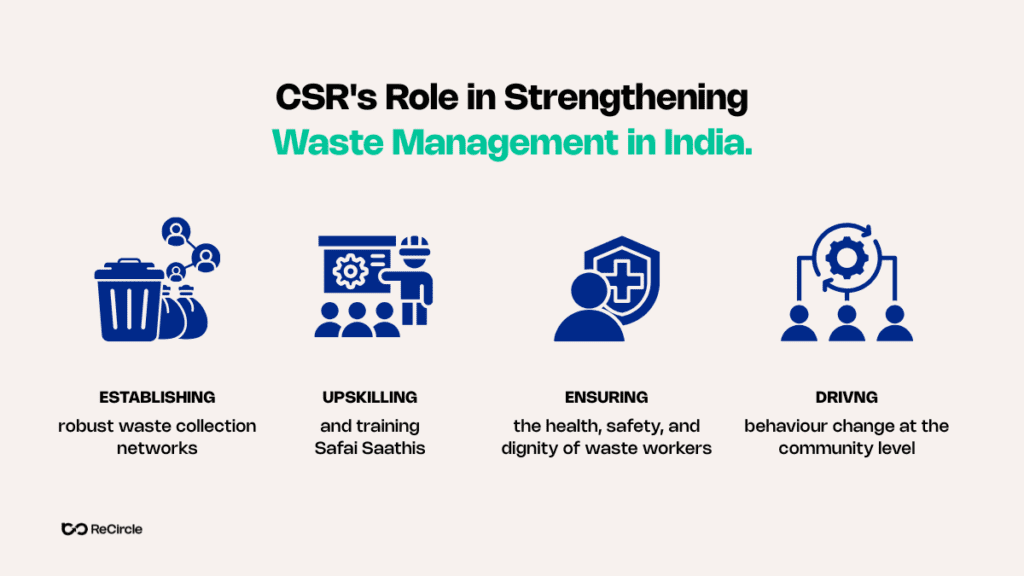
CSR can invest in:
- Waste collection and aggregation networks
- Training and skilling of Safai Saathis
- Health, safety, and dignity of waste workers
- Behaviour change at the community level
Each of these directly improves the efficiency, traceability, and credibility of EPR for plastic waste.
Funding Collection Networks That Power EPR for Plastic Waste
EPR for plastic waste breaks down when plastic is never collected.
CSR funding can strengthen decentralised collection systems by supporting dry waste centres, material recovery facilities, and last-mile aggregation points. When waste is collected closer to the source and better sorted, recycling quality improves, and leakage is reduced.
Better collection means better data. Better data means stronger on-ground reporting, and suddenly, compliance becomes measurable and reliable.
Why Training Safai Saathis Is Non-Negotiable for EPR for Plastic Waste
Safai Saathis are not unskilled workers. They are environmental service providers. Yet most have never received formal training in waste segregation, material identification, or safe handling.
This is where CSR-funded IEC activities make all the difference.
At ReCircle, IEC activities are designed to bridge the gap between opportunity and access. These sessions create spaces where Safai Saathis learn how different plastics behave, why segregation matters, and how their work fits into the larger EPR system for plastic waste.
When workers understand the “why” behind their work, sorting improves, contamination decreases, recovery rates increase, and EPR becomes stronger at the very first step.
How IEC Strengthens the Waste Ecosystem
Information, Education and Communication is often misunderstood as awareness campaigns for citizens alone. In reality, IEC for Safai Saathis is the backbone of extended producer responsibility.
Through regular training, peer learning sessions, and on-ground demonstrations, waste workers become confident, informed, and consistent. This directly improves the quality of plastic entering recycling streams.
For EPR for plastic waste, quality matters as much as quantity.
Formalisation Makes EPR for Plastic Waste Sustainable
EPR cannot rely on invisible labour forever.
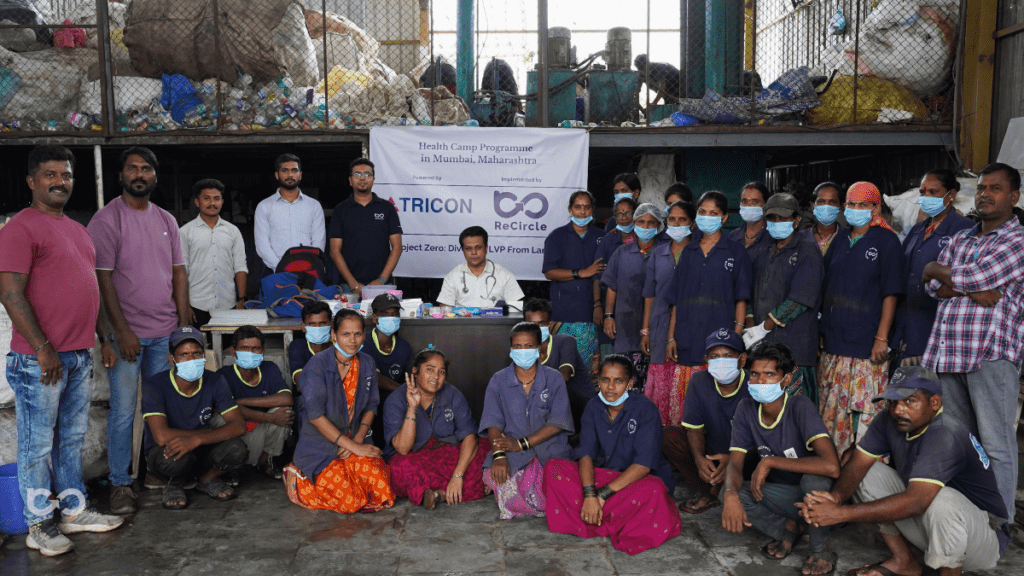
Many waste workers lack basic identification documents, access to healthcare, or safety equipment. CSR can support formalisation by funding PPE, insurance coverage, health checkups, and fair wage structures.
ReCircle’s work focuses on recognition and dignity. When Safai Saathis are formally integrated into waste value chains, attendance improves, data becomes reliable, and collection stabilises.
Stable systems are the foundation of successful EPR for plastic waste.
Health and Dignity Are Operational Needs
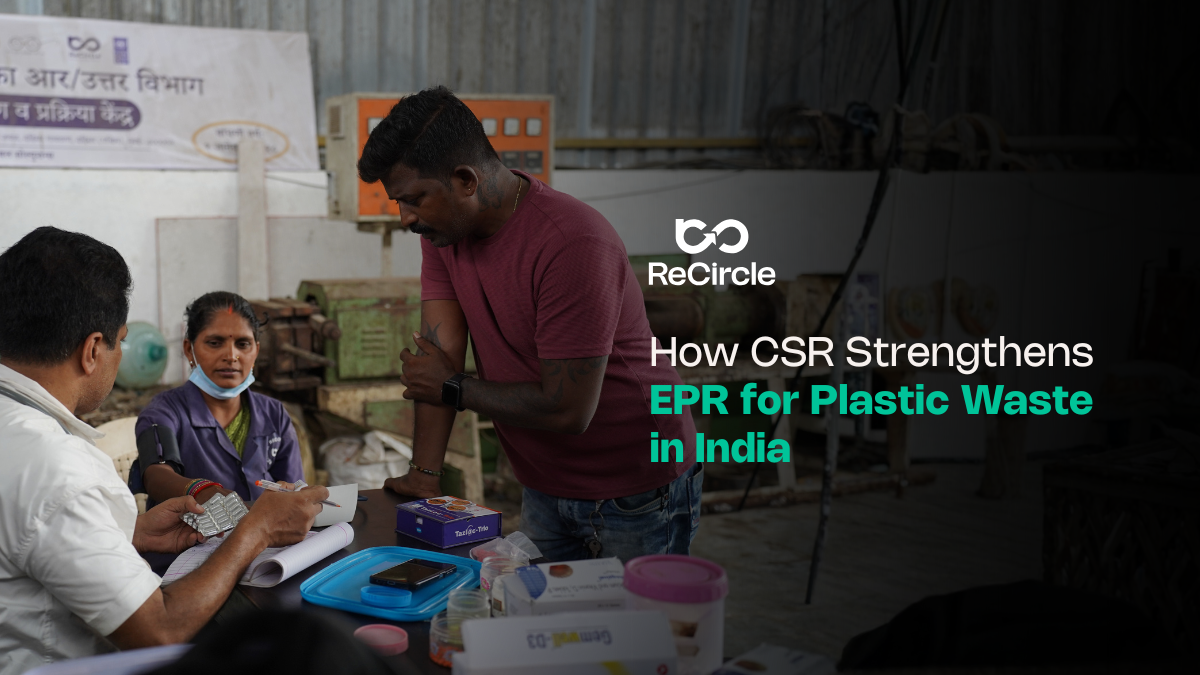
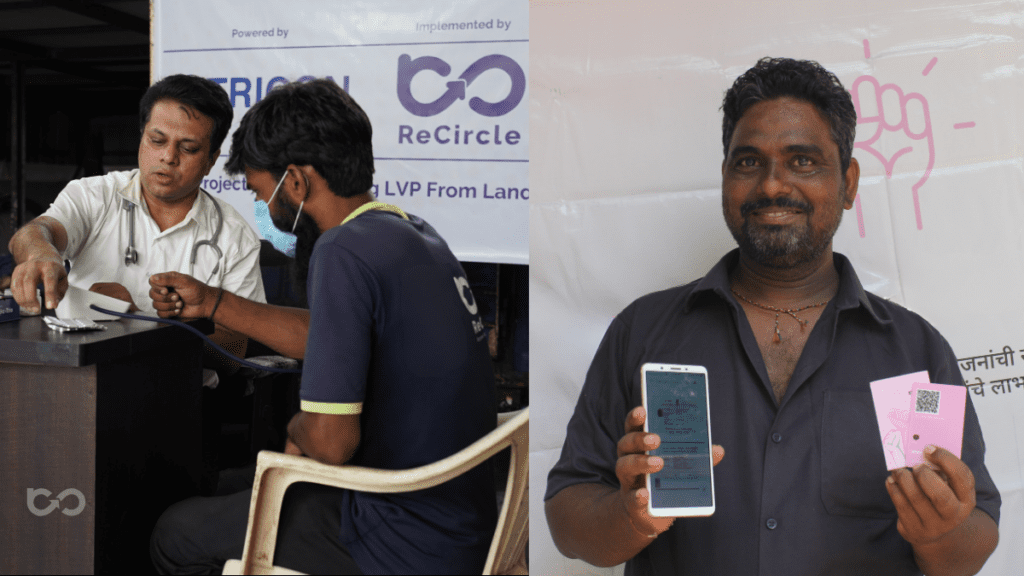
CSR-funded medical health checkups and improved working conditions are not soft benefits. They directly affect how well EPR systems function in the real world.
Healthy workers mean consistent collection, and consistent collection means predictable EPR outcomes.
How ReCircle Connects CSR and EPR for Plastic Waste
At this stage, it becomes easier to see how closely plastic waste management in EPR is linked to what happens on the ground.
And when on-ground systems are weak, inconsistent, or under-supported, achieving EPR for plastic waste becomes difficult, no matter how strong the intent or how clear the targets are.
At ReCircle, strengthening these on-the-ground systems is a core pillar of our work.
We use CSR funding to strengthen the parts of the system that are often overlooked. IEC sessions with Safai Saathis to improve segregation and material handling. Support for documentation, PPE, health checkups, and safer working conditions, so the collection does not fall apart midway. Simple interventions, but they make a visible difference to how much plastic actually gets collected and sorted.
When workers are trained, supported, and recognised, the quality of collection improves, sorting becomes more accurate, data becomes more reliable, and EPR targets become easier to meet.
A Simple Next Step
If your EPR targets feel harder to achieve each year, the issue is rarely intent, but often the system underneath.
CSR can strengthen that system when used deliberately.
ReCircle works with brands that want their EPR for plastic waste efforts to be backed by real collection, real people, and real on-the-ground outcomes.
If you are exploring how to align CSR funding with your extended producer responsibility targets to achieve a practical, measurable impact, reach out to our team today!