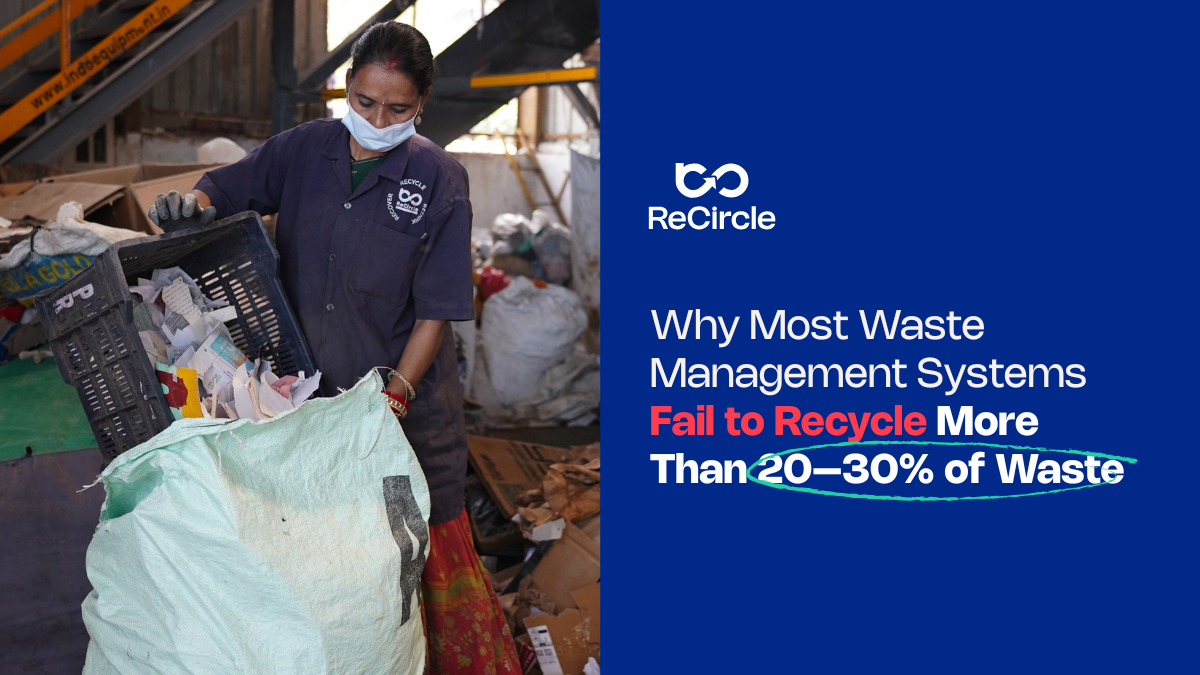
Recycling systems have grown over the last ten years, and more waste is being collected separately. However, when we look at what actually gets recycled, the numbers remain very low across most systems.
This isn’t a failure of intent, it’s a failure of design, process, and alignment. Most waste management systems are built for speed, convenience, and compliance, not material recovery.
This article looks at the practical reasons why recycling remains low in India, where official data shows that only about 6% of municipal solid waste is actually recycled, and explains what systems need to focus on to improve recovery. (Ministry of Statistics and Programme Implementation – EnviStats 2023)
1. Seeing the Reality First-Hand
We’ve spent years observing waste move through real systems from offices and residential complexes to Material recovery facilities. What we see is consistent:
Most systems look functional on paper. Bins are present, trucks run on schedule, and contracts are fulfilled. Yet when we examine the actual outcome, a large proportion of potentially recyclable material never reaches recovery facilities.
Our experience shows that this is not accidental. There are structural, human, and operational reasons why waste systems fail to recycle more than a fraction of what is generated.
2. Source Segregation Often Fails in Practice
Segregation at source is the first step toward higher recycling, yet it is where most systems break down.
While bins are colour-coded and instructions are circulated, reality is different:
- Segregation is inconsistent as people often mix waste for convenience
- Collection staff may ignore segregation to save time
- Contaminated waste enters the system and reduces overall recoverability
We have observed many “fully segregated” sites where, due to minor mixing or contamination, the waste arriving at waste management processing centers is far from fully recoverable.
3. Collection and Transport Erase Recovery Opportunities
Even if segregation at source is partially successful, the way waste is collected often undermines it.
Common issues we observe, particularly outside well-managed Tier 1 city systems, include:
- Collection vehicles that mix dry and wet waste when segregation is not strictly followed
- High compaction during transport, which damages recyclable materials
- Collection schedules focused on speed rather than maintaining material quality
By the time waste reaches waste management facilities, a significant portion is already unrecoverable, and recyclers are often left handling a small fraction of total waste.
4. Sorting Facilities Are Not a Catch-All Solution
Many organizations assume that waste management facilities can compensate for weaknesses upstream. In practice, this expectation is rarely met:
- Sorting is time-consuming and labour-intensive
- Even small amounts of wet or non-recyclable waste mixed earlier in the process can contaminate an entire bag or batch, making it unsuitable for recycling by the time it reaches the facility.
- Multilayer plastics and certain low-value materials are usually diverted to waste-to-energy facilities rather than recycled.
We’ve seen cases where a waste management facility can only recover 40–50% of what arrives because the input quality is poor. If upstream systems fail, even the most advanced sorting facility cannot reach high recycling rates.
5. Human Factors Limit Efficiency
Waste management is as much about people as it is about infrastructure. The systems we observe are only as strong as the workforce operating them.
Key challenges include:
- High turnover among collection staff
- Lack of training on material handling
- Incentive structures tied to tonnage rather than quality recovery
When human systems are not considered in design and incentives, even the best technical systems fail to perform as expected.
6. Material Complexity and Value Constraints
Not all waste is equally recoverable. Many systems assume that all recyclables are equally valuable or easy to process. Reality is different:
- Multilayer packaging cannot be recycled easily
- Low-value plastics cost more to recover than their resale value
- Contamination can reduce the utility of otherwise recyclable materials
Unless systems account for these realities, low-value materials are often ignored, with collectors recovering only those materials that fetch higher value. As a result, overall recycling rates remain low.
7. Measurement and Accountability Gaps
Most systems track the quantity collected or sent for processing but do not measure what is actually recycled or lost at each stage.
Without tracking:
- Material lost due to contamination
- Rejected materials at sorting facilities
- Improper handling during transport
…it is impossible to identify bottlenecks or improve outcomes. In the waste management & recycling industry, systems that implement stage-wise measurement consistently outperform those that do not.
8. Behavioural Assumptions vs Operational Reality
We see a mismatch between system assumptions and real behaviour. For example:
- Instructions assume consistent compliance
- Posters and campaigns assume awareness equals action
In reality, behaviour is influenced by convenience, system reliability, and feedback. If the system consistently undermines good intentions, participants disengage, and recovery drops.
9. Key Actions That Actually Improve Recovery
Based on our experience, meaningful improvement requires intentional design and continuous management:
- Protect segregation throughout collection and transport
- Match sorting infrastructure to the realities of input waste
- Align human incentives with recovery outcomes
- Track material losses at every stage, not just output volume
- Develop strategies for low-value or difficult-to-recycle materials
These practices take effort but dramatically increase recovery rates.
10. Rethinking Waste Management
Most waste systems fail not because of negligence, but because they were never designed to prioritise recycling. Efficiency, speed, and convenience take precedence over material recovery.
To move beyond this low recovery ceiling, the waste management industry needs a systemic approach, one that protects material, empowers people, and measures results across the entire value chain.
When Waste management is approached with recovery as the core objective, not just disposal, recycling stops being a marginal outcome and becomes a measurable impact.
At ReCircle, we design systems that respect both human realities and material value. Our experience shows that when collection, sorting, and incentives are aligned with recovery objectives, recycling rates can rise significantly above the typical 20–30%.
Real recycling begins with honest, practical design not wishful thinking. When systems are built for recovery, rather than removal, impact follows naturally.
FAQs
Q1. Why is it so hard to recycle more than 20–30% of waste?
A: Most systems fail due to:
- Poor segregation at source
- Contamination during collection
- Inefficient sorting processes
- Lack of tracking and accountability
- Limited market for low-value recyclables
Q2. Does collection frequency affect recycling efficiency?
A: Absolutely. Frequent but poorly managed collections can mix recyclable and non-recyclable materials, reducing recovery rates. Proper scheduling and transport practices are critical.
Q3. How important is segregation at source?
A: Source segregation is the foundation of effective recycling. Without it, even advanced sorting facilities cannot recover more than a fraction of waste.
Q4. What role do humans play in waste management efficiency?
A: People are central. Training, incentives, and awareness for collection staff and sorting personnel dramatically affect recovery rates. Systems ignoring human factors often fail.
Q5. How can ReCircle improve recycling efficiency for companies or municipalities?
A: We design end-to-end waste systems focusing on:
- Source segregation
- Optimized collection and transport
- Advanced sorting and monitoring
- Stage-wise tracking to maximize recovery