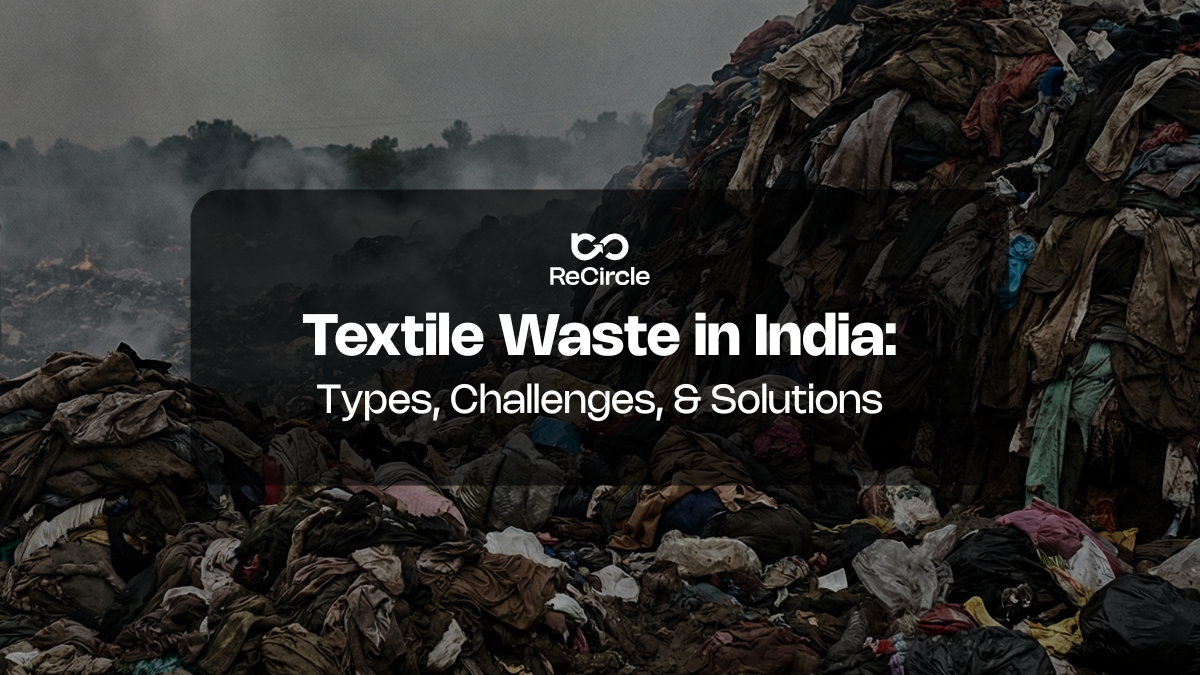
Description: Discover the main types of textile waste in India and how improved textile waste management can turn these discarded streams into value.
Textile Waste management in India is often discussed only at the very end of a product’s life, when clothes are already torn, dumped, or forgotten. However, these remnants do not suddenly appear when something is thrown away.
This cycle begins much earlier, during manufacturing, continues quietly during consumer use, and finally reaches a stage at which its value is either recovered or lost permanently.
Understanding the full lifecycle of textile waste is essential if India wants to move from landfilling to building a truly circular economy.
Understanding Textile Waste Management in India
At its core, Textile Waste management in India involves the collection, sorting, reuse, recycling, and disposal of leftover fabrics generated throughout the supply chain. This includes factory-generated scraps, household-discarded items, and imported materials.
India generates more than 7 million tonnes of textile waste annually, accounting for nearly 8% of the global total. Yet only slightly over 10% of this is currently part of circular value chains. This substantial gap primarily arises because different categories of discarded fabric require distinct handling systems.
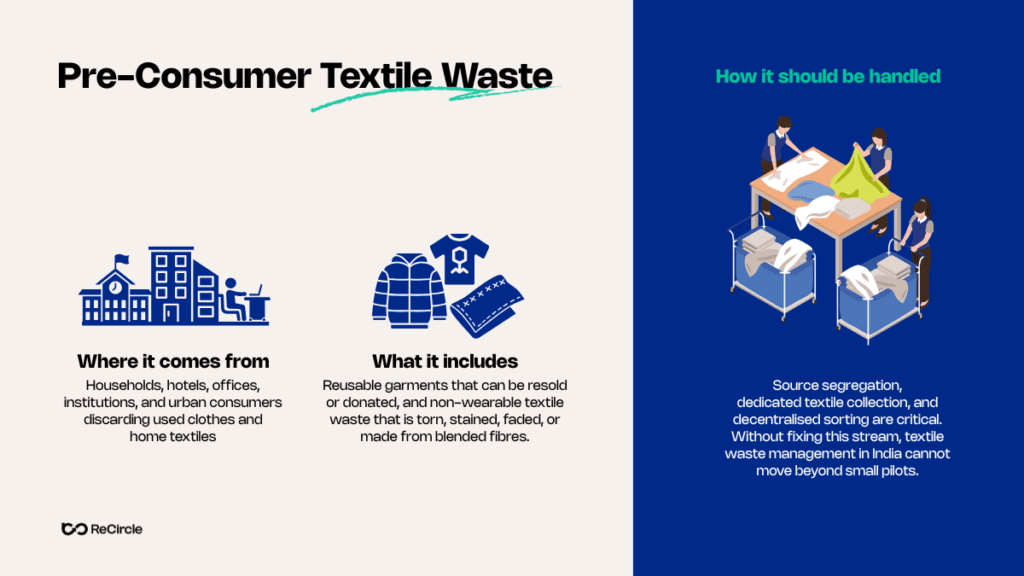
Pre-Consumer Textile Waste
Pre-consumer textile waste is generated before garments reach consumers and accounts for approximately 42% of total textile volume in India.
Where it comes from: This type of scrap is generated during yarn spinning, fabric weaving and knitting, wet processing, garment cutting, sampling, and quality checks in factories.
What it includes: Yarn waste, fabric selvedge, cutting scraps, rejected batches, excess production, and unsold stock that never reach retail shelves.
Why does it hold the most value? These materials are usually clean and have a known fibre composition. As a result, they are the preferred input for mechanical recyclers, particularly when cotton-rich.
What limits recovery: Although easier to recycle, capacity is not keeping pace with production growth. Production is increasing at nearly 10% annually, whereas recycling capacity grows by only 3-4%.
How it should be handled: Strong factory-level segregation, traceability, and direct linkages with recyclers are essential. Improving recovery here is one of the fastest wins for textile waste management in India.
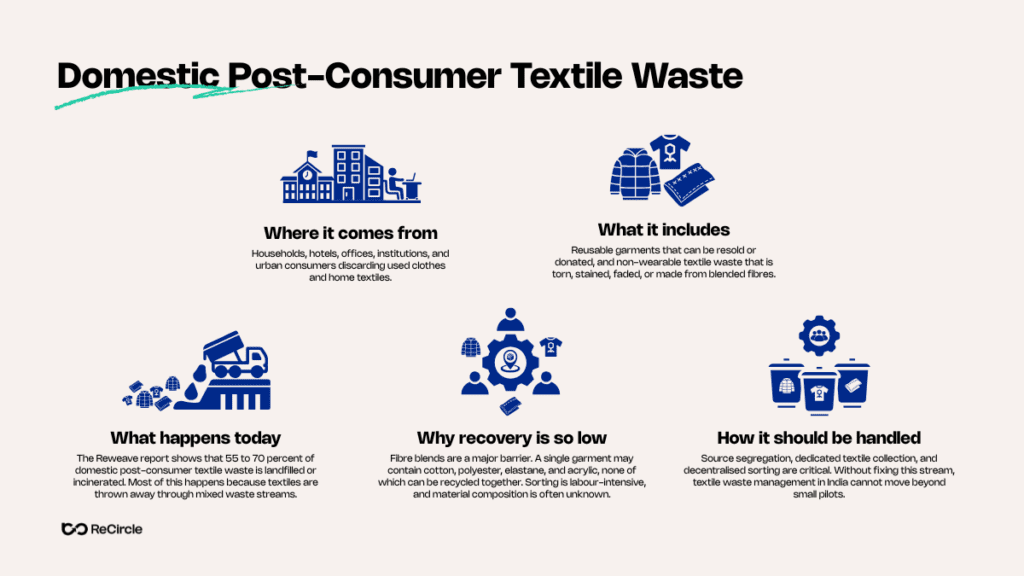
Domestic Post-Consumer Textile Waste
Domestic post-consumer textile waste is the largest category, accounting for approximately 51% of the volume in India and posing the most significant challenge.
Where it comes from: Households, hotels, offices, institutions, and urban consumers who discard used clothing and home textiles.
What it includes: Reusable garments that can be resold or donated, and non-wearable items that are torn, stained, faded, or made from blended fibres.
What happens today: Studies show that 55-70% of domestic post-consumer textile waste is landfilled or incinerated. Most of this occurs because textiles are discarded in mixed waste streams.
Why is recovery so low? Once discarded items are mixed with food, moisture, or dust, recovery becomes extremely difficult. Fiber blends are another barrier; a single garment may contain cotton, polyester, and elastane that cannot be recycled together.
How it should be handled: Source segregation, dedicated textile takeback programmes, and decentralised sorting are critical. Without fixing this stream, textile waste management in India cannot move beyond small pilots.
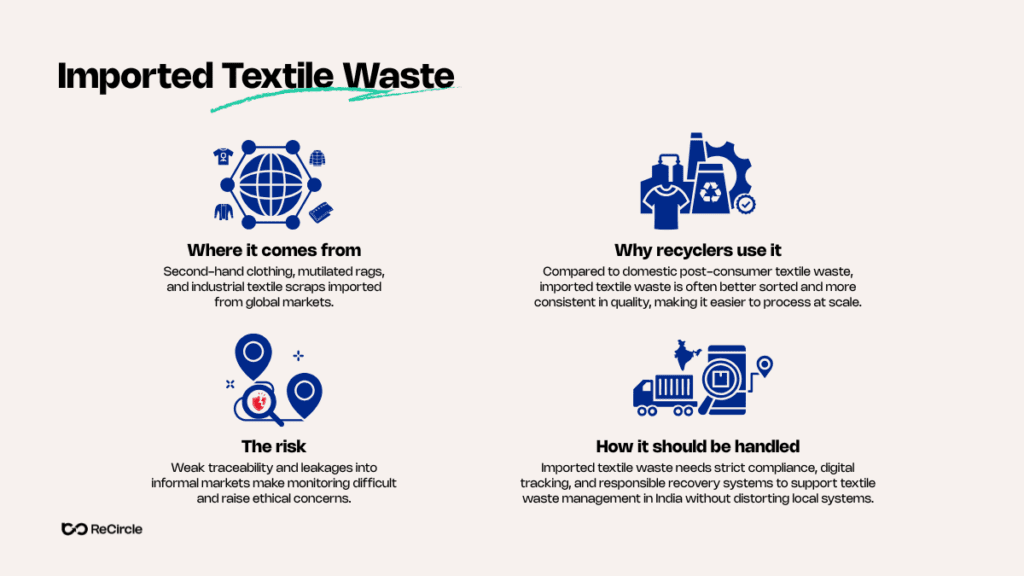
Imported Textile Waste
This category accounts for approximately 7% of total textile waste in India, but plays a key role in recycling systems.
Where it comes from: This includes second-hand clothing, mutilated rags, and industrial scraps sourced from global markets.
Why recyclers use it: Compared to domestic post-consumer items, imported materials are often better sorted and more consistent in quality, making them easier to process at scale.
The risk involved: Weak traceability and leakages into informal markets make monitoring difficult and raise ethical concerns.
How it should be handled: Strict compliance, digital tracking, and responsible recovery systems are needed to support textile waste management in India without distorting local systems.
What Textile Waste Is Made Of
Approximately 60% of textile waste in India consists of cotton or cotton-rich blends. However, synthetic scraps, especially polyester, now account for nearly 20% and this share is growing rapidly.
Polyester and blended materials have limited recycling pathways. Most of it is downcycled into felt, insulation, wipes, or mattress stuffing, or is discarded altogether. This material shift is quietly increasing pressure on textile waste management in India.
Why These Categories Matter
Not all discarded fabrics are the same. A clean cotton cutting scrap, a mixed-fibre household garment, and imported rags each require distinct recovery pathways.
When discarded fabrics are treated as a single problem rather than multiple ones, value is lost, and landfills expand. Precise classification is the foundation of effective textile waste management in India.
Closing the Loop
Textile waste is increasingly resembling plastic waste. It’s everywhere, hard to ignore, and growing fast. But just like plastic waste, textile waste also holds real value when it’s recovered responsibly. The problem isn’t the material; it’s how we handle it.
If you’re part of the textile industry, this is your chance to do things differently. Building ethical recovery systems and circular textile supply chains today isn’t merely good practice; it’s also the only way to future-proof your business.
If you are working with textiles, let’s discuss how we can recover them responsibly and ethically
Contact us to explore ethical recovery and future-ready supply chains.
Frequently Asked Questions
• Pre-Consumer: Clean manufacturing scraps generated in factories during production processes like cutting and spinning.
• Domestic Post-Consumer: Used clothing and home textiles discarded by households, often mixed with other waste.
• Imported: Second-hand garments and industrial rags sourced from global markets to support local recycling.